Supplement Fulfillment from China in 2026: cGMP 3PL, FDA Traceability & Amazon/TikTok Compliance Guide
Supplements in 2026 aren't a margin story—they're a permission story. This guide maps the three business models, four regulatory pressures, a ten-market certification map, and the four-layer compliance stack your fulfillment partner must cover.


In 2026 supplements are a "permission story," not a margin story—one brand's clean 14,000-unit Amazon listing went dark in 91 days for lacking third-party cGMP verification.
Match your business model to your stage: Stock Dropship (market-testing), Private Label (brand-building), and Custom OEM (moat-building) each carry a different capital and compliance burden.
Four regulatory forces converged within 12 months—Amazon cGMP mandate, FDA Ingredient Traceability Code (Oct 1, 2026), TikTok Shop logistics instability, and Brazil ANVISA IN 431/438—and your fulfillment partner sits in the middle of all four.
The supplement industry in 2026 is no longer driven by simple product arbitrage. Consumers now follow a “Food First, Supplement Second” mindset, while platforms and regulators are tightening compliance across every major market. At the same time, operators are choosing between three core growth models — Stock Dropshipping, Private Label, and Custom OEM — based on business stage, capital structure, and long-term brand goals.
Behind the growth opportunity sits a more complex reality: Amazon cGMP enforcement, FDA traceability requirements, TikTok Shop logistics instability, and new ANVISA regulations are changing how supplement businesses source, fulfill, and scale globally. Cross-border sellers must now navigate multiple certification systems, from FDA and cGMP standards in the U.S. to TGA in Australia and halal certification in Southeast Asia.
For most operators, the real challenges are no longer finding products. The pressure comes from unstable supply chains, compliance risks, weak branding assets, shrinking margins, high OEM MOQs, and difficult after-sales operations. The right supply chain partner now plays a central role in solving these structural problems.

The 14,000-unit story: How a clean Amazon listing went dark in 91 days
A U.S. supplement brand we spoke with last quarter sold 14,000 units of a magnesium glycinate SKU over the prior twelve months. Repeat-purchase rate above category average. Clean review distribution. The kind of catalog you’d quietly describe as boring — in the good way.
In February 2026, they received an Amazon compliance notice giving them 90 days to submit third-party cGMP verification through an Amazon-approved Testing, Inspection, and Certification provider. They had no relationship with their Chinese contract manufacturer’s auditor. They had no Certificate of Analysis on file beyond what shipped with the most recent lot. They had no batch traceability beyond a sticker on the master carton.
The listing came down on day 91. Inventory worth roughly USD 180,000 sat in a 3PL warehouse, losing about USD 4,000 a month in storage fees while the brand hastened to rebuild a compliance chain it had never bothered to construct.
This is the supplement category in 2026. It isn’t a margin story. It’s a permission story.
Supplements are the category where ‘certainty’ isn’t a premium feature — it’s the entry ticket.
Operators who treat this category like any other dropshipping vertical (find product, find supplier, find shipper) discover, usually too late, that the marketplaces, the regulators, and the customs authorities have already converged on a much narrower definition of who’s allowed to operate. The framework for choosing a supply chain ahead of that convergence is in How Should You Choose a Supplement Supply Chain; the wider market-entry decision is analyzed in Is the Supplement Market Still Worth Entering. This article picks up where both of those leave off: what happens after you’ve decided to operate, and what your fulfillment layer has to look like to keep operating.
We’ll return to the 14,000-unit story at the end — specifically, to the five questions the brand wishes it had asked its manufacturer 18 months earlier.
The principle that frames every supplement decision — Food First, Supplement Second
Before any conversation about SKUs, manufacturers, or marketplaces, the operators who scale durably in this category share a working principle that almost everyone repeats and almost no one acts on: supplements complement diet, they don’t replace it. The product’s job is to fill a specific nutritional gap — not to be sold like a commodity dropship SKU through whichever ad creative converts best this week.
The practical consequence runs through every downstream decision. A brand built on “Food First, Supplement Second” tends to:
- Frame products by gap, not by category. A vitamin D3 SKU isn’t marketed as “the best D3 on Amazon.” It’s marketed to the specific population that has measurably low D3 (indoor workers, higher latitudes, older adults) and pairs naturally with the food groups they’re under-consuming.
- Accept three operating principles: personalization (the right active for the right consumer), necessity (there’s actually a gap to fill), safety (the dosage doesn’t cross into harm). These three aren’t marketing language — they’re the underlying logic that determines which SKUs survive the regulatory and marketplace filters described later in this article.
- Refuse the temptation to overstate the active. Fat-soluble vitamins (A, D, E, K) and certain minerals carry real toxicity risk at supraphysiological doses. Water-soluble vitamins (B-complex, C) are safer but still not appropriate for indefinite mega-dosing. Botanical extracts (ginkgo, ginseng) interact with anticoagulants and other medications. Operators who treat these as features-on-a-label rather than active interventions invite both consumer harm and regulatory attention.
The “Food First” frame is what makes the rest of this article actionable. Without it, every decision below — model choice, manufacturer choice, fulfillment partner choice — gets made on the wrong axis.
The three business models — Stock Dropship, Private Label and Custom OEM
Almost every operator selling supplements sourced from China in 2026 falls into one of three business models. The three aren’t interchangeable. Each carries a different capital profile, a different compliance burden, and a different stage-of-business fit.

Stock Dropship — the market-testing layer
Stock dropship is how almost every new supplement operator should start. The supplier holds the inventory in a 21 CFR Part 111-compliant facility, the brand markets it, and orders ship one at a time as they come in. The brand’s capital exposure is approximately zero; the brand’s margin is also compressed because the SKU is, by definition, not unique. The model’s job is to answer one question quickly: Does this product, at this price, with this creative, actually convert with this audience?
The failure mode is treating stock dropship as a destination rather than a test. Brands that scale to a USD 50K-100K monthly run rate on commoditized SKUs and stay there indefinitely watch their margin compress every quarter as new entrants copy the listing and bid the price down. The model only works as a stepping stone.
Private Label — the brand-building layer
Private label takes a manufacturer’s existing formulation and applies the brand’s label, packaging, and positioning. MOQ typically lands in the 1,000-5,000 bottle range for each SKU, depending on the contract manufacturer and the dosage format. Working capital commitment is real; the offsetting benefit is that the brand now owns the listing identity and can price above the commodity. Most operators move into private label after a stock dropship has validated demand for a specific category.
Private label is also where the compliance burden starts to land on the brand directly. Once the bottle carries your name, your name is on the customer complaint, the FDA notice, and the Amazon listing-removal letter. The contract manufacturer’s cGMP audit and the brand’s documentation discipline become inseparable.
Custom OEM — the moat-building layer
Custom OEM means the brand commissions a proprietary formulation, ingredient ratio, or delivery system. MOQ generally moves into 5,000-20,000+ units per unit, and lead times extend from weeks to a few months. The reward is structural: the formula is the brand’s, the supply chain is locked, and the listing is genuinely defensible against copycats. The model fits brands with proven category traction, willingness to commit capital, and a multi-year horizon. It does not fit operators still hunting for product-market fit.
The right model is almost always a function of the brand’s stage rather than the brand’s preference. The 14,000-unit brand from the opening was operating in private label on a contract manufacturer they had never audited — a configuration that worked beautifully right up until Amazon asked for the audit report.
What actually changed in 2026 — four regulatory pressures, one twelve-month window
The reason supplement fulfillment from China feels structurally different in 2026 isn’t any single rule change. Four separate regulatory forces — each significant on its own — landed within roughly twelve months of each other, and the compounding effect is what the category is still digesting.

Amazon’s cGMP verification mandate — the 90-day clock that’s already running
Amazon expanded its third-party Testing, Inspection, and Certification requirement from a narrow set of high-risk supplement categories to every dietary supplement sold on the marketplace. Sellers are contacted in waves; from the date of contact, they have 90 days to submit a cGMP facility verification from an approved TIC organization such as NSF, USP, Eurofins, UL, or Intertek. As one early-wave seller documented on r/FulfillmentByAmazon, “we are approaching day 90 for many of the brands that were contacted in the initial wave” — and the listing-removal letters are already going out.
This is not FDA facility registration, which has always been a legal requirement and confers no quality assurance. This is independent laboratory verification that the manufacturing facility actually follows 21 CFR Part 111. The two are routinely confused, and the confusion is currently the single biggest source of Amazon listing suspensions in the category.
The FDA Ingredient Traceability Code — effective October 1, 2026
FDA guidance now mandates that imported dietary supplements include an Ingredient Traceability Code on the product label, with port rejections likely if the code is absent. The intent is to make every ingredient in a finished supplement traceable back to a verified raw-material source — a structural response to the chronic problem of ingredient substitution and undeclared adulteration in cross-border supplement supply chains.
For brands using Chinese contract manufacturers, this means the trace data has to exist not just in the Certificate of Analysis but on the label itself, with the chain of custody documented from raw material through bottling. With the deadline less than five months out, suppliers without a documented plan to print or apply the code are about to become non-shippable for U.S. imports.
TikTok Shop’s logistics whiplash — February 25 → February 17 reversal
On February 25, 2026, TikTok Shop announced it would discontinue Seller Shipping for all U.S. sellers and force every order by TikTok Shop Logistics Services by March 31. After sustained backlash from brands worried about margin compression and the readiness of TikTok’s in-house logistics, the platform paused the mandate on February 17. As of the most recent 3PL Center update, sellers can continue using their existing fulfillment provider — but the floor is no longer stable.
Operators building supplement businesses on the TikTok platform Shop are now structurally exposed to a fulfillment policy that could change again with little warning. Layer that on top of TikTok’s existing rules — 2-3 business-day shipping SLA, late-shipment rates kept under 4% or sight penalties kick in — and the brands handling this best are running multi-model 3PLs that can flex between Seller Shipping, TikTok Shipping, and Fulfilled by TikTok without re-platforming inventory.
Brazil ANVISA IN 431 + IN 438 — two rules in three weeks
For brands selling supplements for Brazil — a market that’s seen sustained DTC growth across collagen, vitamins, pre-workout, and weight-management categories — ANVISA published Normative Instruction 431 on April 2, 2026, updating the positive list of authorized constituents, use limits, claims, and complementary labeling rules. Three weeks later, IN 438 added strict adult-only dosage rules for Curcuma longa extracts.
Both regulations entered into force immediately on publication, with transition periods of six to twenty-four months depending on the product. Operators who localized their formulations to Brazilian taste two years ago and never re-checked the constituent list are now sitting on SKUs that may need reformulation, relabeling, or both.
None of these four pressures will reverse. The 2026 reality is that a supplement brand operating from China has to satisfy four compliance regimes simultaneously — facility verification, ingredient traceability, marketplace fulfillment policy, and destination-market labeling — and the fulfillment partner sits in the middle of all four.
The ten-market certification map — what you actually need where
The four marquee pressures above (Amazon, FDA, TikTok, ANVISA) get most of the attention because they hit U.S. and Brazilian operators hardest. The wider picture for any brand exporting supplements from China is that ten distinct regulatory regimes typically appear across a single year of cross-border operation. The exact certificate names vary by market, and a manufacturer that’s serious about exports holds at least the certificates relevant to the markets it actually ships into.
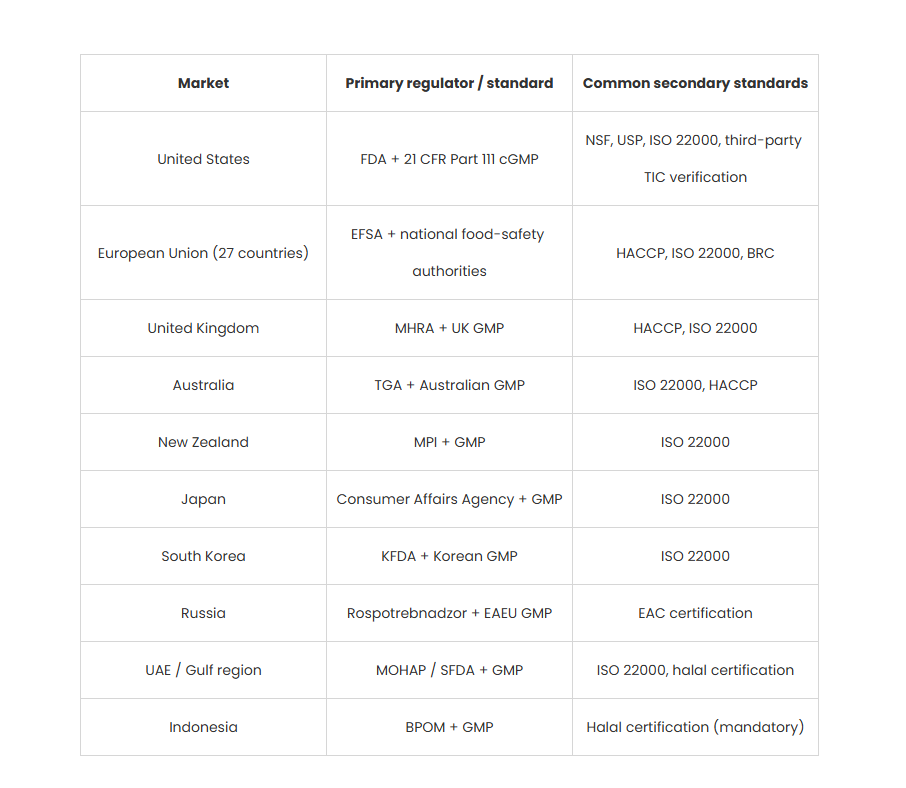
Three pragmatic implications. First, multi-market sellers should screen manufacturers by certification breadth, not by a single certificate — a factory with FDA registration but no HACCP cannot reasonably enter the EU without a long onboarding process. Second, halal certification is mandatory for Indonesia and increasingly important across the Gulf and parts of Southeast Asia; brands ignoring it foreclose those markets without realizing it. Third, dual-purpose certifications like ISO 22000 (food safety management) and HACCP (hazard analysis) appear in nearly every market and are usually the fastest signal that a manufacturer takes export seriously.
FFOrder’s procurement layer works primarily with Chinese contract manufacturers concentrated in the Guangzhou cluster (alongside specialist factories in Henan, Shandong, Anhui, and Hubei) — the geography that holds the densest concentration of multi-certificate supplement producers in China. The technical detail behind sourcing from this cluster is in the supplement fulfillment industry brief.
The compliance stack — four layers, four independent failure modes
The phrase “compliant 3PL” is used so casually in this category that it’s almost stopped meaning anything. Operators who avoid the worst outcomes treat compliance as a stack with four distinct layers, each of which can break independently.
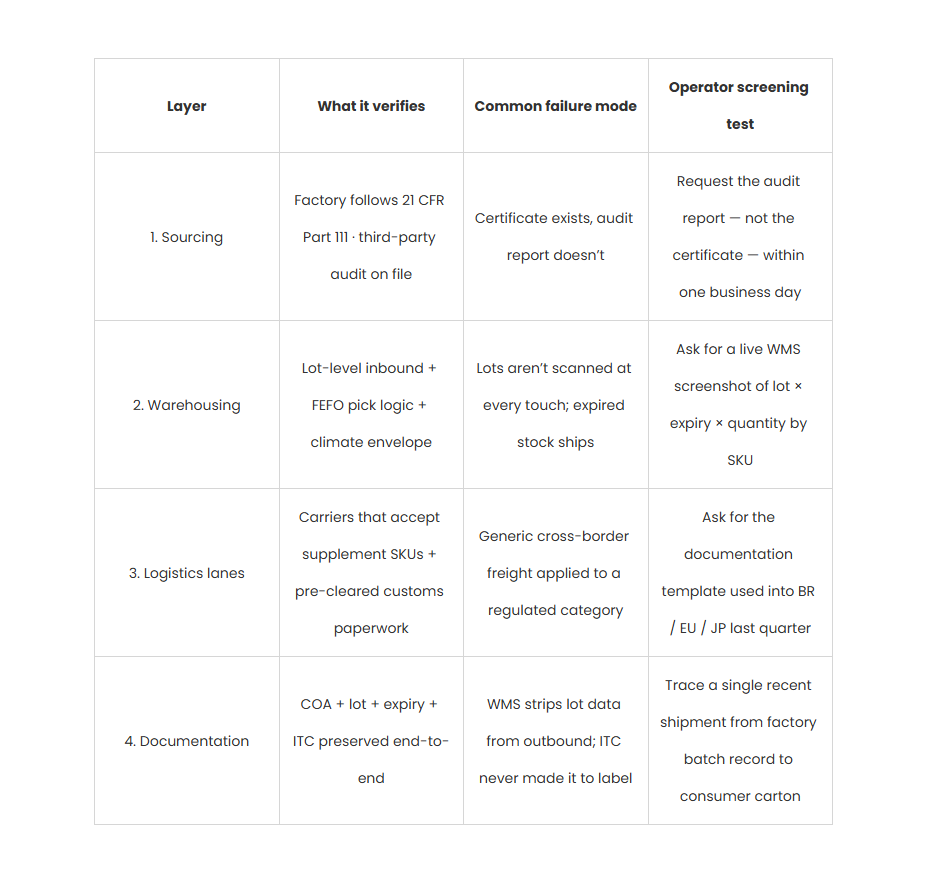
Layer 1 — Sourcing: where the audit report matters more than the certificate
cGMP verification, FDA registration, and ingredient documentation start at the factory, not the warehouse. A 3PL can be perfectly compliant and still ship a product that fails Amazon’s TIC verification because the manufacturer behind the SKU isn’t actually running 21 CFR Part 111 protocols. Operators who own this layer typically work with manufacturers that hold at minimum NSF 229 China GMP registration — a program NSF launched in 2023 specifically to combine Chinese national standards with U.S. FDA GMP requirements — or equivalent third-party audits from USP, BRC, or Eurofins.
The second-order test that separates a serious supplement supplier from a dropshipping reseller: ask for the most recent third-party audit report. Not the certificate. The actual report, with findings and corrective actions. Suppliers who can produce that document within a business day are operating at the level the category now requires. Suppliers who can produce only a glossy certificate without the underlying audit detail are almost certainly licensing the certificate name, not the operational discipline behind it.
Layer 2 — Warehousing: where FEFO either exists or doesn’t
The storage and pick layer is where lot tracking and expiration management either exist or don’t. A supplement warehouse without First-Expired-First-Out (FEFO) allocation logic wired into the WMS will quietly ship product approaching expiry to customers ahead of fresher stock, generating exactly the kind of complaints that Amazon, TikTok Shop, and Mercado Livre treat as listing-quality signals.
The technical requirement is simple: every inbound SKU is received against a lot number and an expiration date; pick logic gives precedence to the earliest-expiring lot first; expired inventory is automatically blocked from shipping. The operational requirement is harder: warehouse staff have to actually scan lots at every touch, every time, and the system has to refuse to release stock that’s missing data.
Climate control is the second non-negotiable. Supplements with sensitive actives — probiotics, fish oils, certain botanicals — degrade in uncontrolled storage and arrive at the consumer with reduced potency. The cost of climate-controlled storage is real (typically a 15–25% premium over standard 3PL rates), and a 3PL pitching supplement fulfillment at standard ambient pricing is almost certainly not running the temperature and humidity envelope the category demands.
Layer 3 — Logistics lanes: where generic cross-border freight breaks
This is the layer most consumer dropshipping operators have never encountered, because consumer goods rarely care about it. Supplements care a lot. Many carriers either prohibit or heavily restrict the shipment of supplements containing certain ingredients (caffeine concentrates, certain botanicals, anything with even a trace of regulated compounds) or demand specialized documentation. Air freight on supplements with active probiotics or any temperature-sensitive ingredient demands different handling than standard parcel air. Cross-border supplement shipments into countries with active regulators — Brazil, the EU, Japan, Australia — require pre-cleared documentation that generic dropshipping freight forwarders simply don’t carry.
The practical implication: a supplement brand can’t use the same logistics infrastructure it uses for apparel or accessories. Category-restricted dedicated lanes are the structural solution — pre-cleared customs paperwork, carriers that accept the SKU mix, and documentation templates aligned to the destination market’s regulatory regime.
Layer 4 — Documentation: the layer that gets stripped on the way out
The overlooked layer. Every shipment of a regulated supplement should leave the warehouse with a documentation packet that includes a Certificate of Analysis for the lot, lot number printed on every carton, expiration date visible without opening, and (from October 2026) the FDA Ingredient Traceability Code on the consumer label. Imports of dietary supplements entering the U.S. are also governed by modified Foreign Supplier Verification Program rules under 21 CFR 1.511.
Documentation issues are where customs holds happen, where Amazon compliance reviews fail, and where ANVISA notifications get rejected. The 3PL doesn’t generate this documentation — the manufacturer does — but the 3PL has to preserve and ship it intact, which requires WMS configuration that most generic 3PLs don’t bother with.
The six operator pain points — and the structural fix for each
When FFOrder’s procurement team talks to supplement brands in 2026, six pain points come up consistently — regardless of marketplace, region, or business model. Each is solvable, but the solution is structural rather than tactical.
Pain 1 — Supply instability
The SKU is selling. Then the manufacturer suddenly can’t fulfill, or the lead time triples, or the formula quietly changes between lots and consumer reviews catch it.
Structural fix: move from one-off orders to a contracted OEM or ODM relationship with locked production slots, formalized lead times, and a clause that requires advance notice of any formula change. Stock dropship is a market test; long-term operators always migrate to contractual supply.
Pain 2 — Compliance gaps that surface late
The brand discovers, usually when Amazon contacts them or a customs hold happens, that the manufacturer’s compliance documentation has holes — missing audit reports, missing lot-level COAs, missing certifications for the destination market.
Structural fix: a 1:1 compliance match against the destination markets the brand actually ships into, conducted before the first PO — not after the first incident. The certification map from the prior section is the screening tool.
Pain 3 — No marketing assets
The brand has a product, but no factory-grade photography, no lifestyle imagery, and no clean ingredient renders for the listing. Generic stock photos kill conversion and signal a commodity SKU to algorithms.
Structural fix: factory-side asset production as part of the supply relationship — clean white-background SKU shots, online production photography for transparency content, sample units for influencer seeding, and a curated content kit for each SKU.
Pain 4 — Transparent margins on commoditized SKUs
Every competitor is sourcing the same generic magnesium glycinate or generic ashwagandha from a small set of contract manufacturers. The listing photo is identical. The price floor collapses within months of launch.
Structural fix: differentiated formulation, packaging, or dosage format — i.e., move from stock dropship to private label, and from private label to custom OEM once volume justifies it. The three-model progression earlier in this article is the migration path.
Pain 5 — High MOQ on private label and OEM
The brand is ready to move past stock dropship, but the quoted MOQ on a private label SKU is 10,000 bottles, and the working capital isn’t there.
Structural fix: same-category order consolidation — multiple brands or multiple SKUs sharing a production run on the same active ingredient and dosage format. A procurement layer with deep manufacturer relationships can stage these consolidations; an arms-length broker generally cannot.
Pain 6 — Complex after-sales
A bottle arrives damaged. A consumer reports a reaction. A lot needs to be recalled. The brand’s 3PL has no protocol; the manufacturer is across an ocean and a time zone; the marketplace gives the brand 48 hours to resolve.
Structural fix: a tiered after-sales protocol matched to the business model — unconditional refund/replacement on stock dropship and simple private label, full traceability and root-cause documentation on custom OEM, dedicated account management with a defined response window across all three.
The eight dosage formats — which ones survive cross-border better
A detail almost no operator considers until it bites them: the dosage format materially affects fulfillment cost, customs complexity, and shelf-life management. Supplement manufacturers in China cover eight common formats. Each has a different profile for cross-border supplement fulfillment.
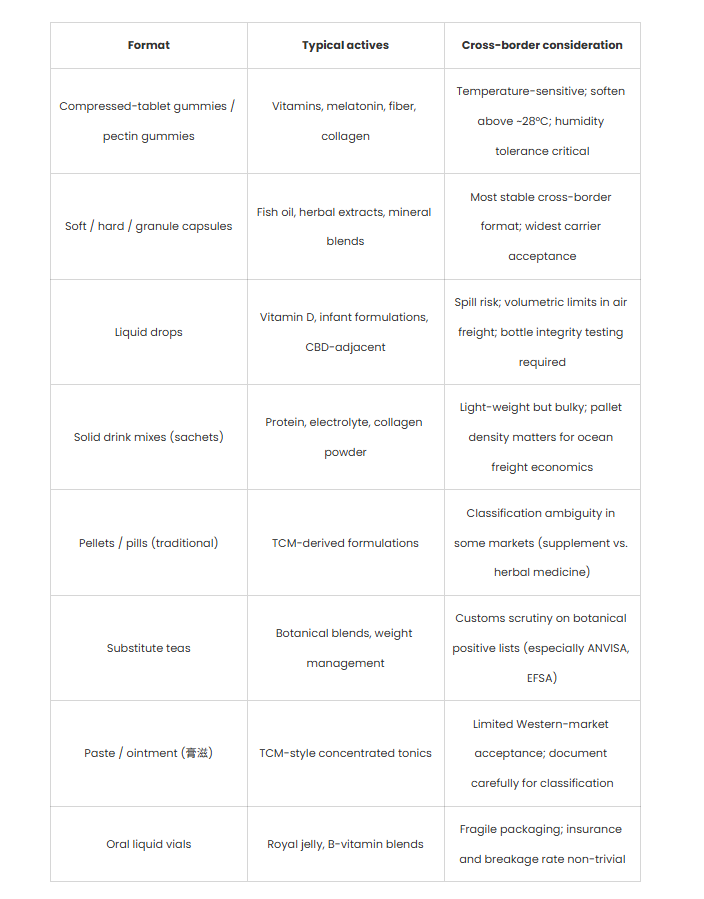
Three practical takeaways. Capsules are the safe cross-border default — stable temperature profile, widest carrier acceptance, simplest customs classification. Gummies are the marketing winner, but the logistics challenge — TikTok Shop and Amazon both love them, but they require climate-controlled lanes that not every 3PL operates. Traditional formats (pellets, pastes, oral liquids) can be excellent for specific markets (Asia, parts of Latin America) but introduce classification ambiguity in Western regulatory regimes and often need market-by-market validation.
FFOrder’s Service Advantages

For brands evaluating whether this stack fits their current scene, the sensible next step is to read the supply-chain selection framework in How Should You Choose a Supplement Supply Chain and the market-entry argument in Is the Supplement Market Still Worth Entering before any procurement conversation begins. Operators running across TikTok, Amazon, and DTC simultaneously can find the cross-marketplace architecture in our DTC e-commerce fulfillment solution overview.
FAQ
What's the difference between an FDA-registered facility and a cGMP-verified facility?
FDA registration is a legal requirement for any facility that manufactures, packs, or holds food or supplements for U.S. consumers — it's free, automatic on submission, and confers no quality assurance. cGMP verification is an independent third-party audit confirming the facility actually operates under 21 CFR Part 111 protocols. Amazon's 2026 mandate requires the second, not the first. The two are frequently confused in supplier marketing, and the confusion is a major cause of listing suspensions.
Should I start with Stock Dropship, Private Label, or Custom OEM?
Almost always, Stock Dropship for the first 90-180 days. The model has zero capital exposure and exists specifically to answer the question of whether the product, price, and audience actually convert. Once unit economics are validated and a SKU has a repeatable monthly run rate, Private Label is the next step — owned brand, higher price acceptance, MOQ accepted. Custom OEM only makes sense after a SKU has clear category traction and the brand can commit to a multi-month production cycle.
Do I need an Ingredient Traceability Code on every supplement label by October 2026?
Yes, for any dietary supplement imported into the United States with ingredients sourced from China. The code links each ingredient back to a verified raw-material source. Labels printed before the effective date that lack the code will be subject to port rejection on entry. Operators should plan label revisions now with their contract manufacturer rather than wait.
Which dosage format is safest for cross-border supplement fulfillment?
Capsules — soft, hard, or granule. They tolerate a wider temperature range than gummies, ship without the spill risk of liquids, classify cleanly in most customs regimes, and have the widest carrier acceptance. Gummies are the consumer favorite and the marketing winner, but they require climate-controlled lanes and humidity discipline that not every 3PL operates. Liquid drops and oral vials carry the highest fragility and air-freight constraints.
Are fat-soluble vitamins really dangerous at high doses?
Yes, meaningfully. Vitamins A, D, E, and K accumulate in body fat rather than being excreted in urine, which means supraphysiological dosing over time can build to toxic levels. Vitamin A toxicity, vitamin D toxicity, and vitamin K interactions with anticoagulants are well documented. Water-soluble vitamins (B-complex, C) are forgiving but not infinitely so — multi-gram daily vitamin C can cause GI distress, and high-dose niacin has its own risks. Botanicals like ginkgo and ginseng increase bleeding risk and interact with several common medications. Operators marketing in this category should correspond to dosage to evidence and avoid "more is better" claim language; the regulators are paying attention.
Can I use the same 3PL for supplements and other product categories?
Technically, yes; operationally, not advisable. Shared-facility 3PLs without segregated supplement zones, dedicated lot tracking, climate envelopes, and FEFO allocation will degrade product quality and create contamination-risk language in any audit. Brands that scale past USD 1M in supplement revenue almost universally move to dedicated supplement fulfillment or to a 3PL with a segregated supplement operation.
What is FEFO, and why does it matter for supplements?
First-Expired-First-Out is the inventory allocation rule that ships the earliest-expiring lot of a SKU before later-expiring lots, regardless of when each lot was received. For supplements — where expiration is a real product attribute, not a regulatory formality — FEFO is the difference between consumers receiving product with 18 months of shelf life remaining versus product with 4 months remaining. The latter generates complaints, returns, and listing-quality penalties.
What does NSF 229 China GMP actually certify?
NSF 229 is a registration program launched by NSF in 2023 specifically for nutritional supplement manufacturers in China. It combines audit requirements from Chinese national manufacturing and product safety standards with U.S. FDA GMP requirements. It's a reasonable shortcut signal when evaluating a Chinese supplement manufacturer for U.S. market readiness — but it doesn't replace independent verification of the specific batch you're shipping.
Does TikTok Shop still require its own logistics service in 2026?
No, not as of the February 17, 2026, reversal. Sellers can continue using their existing fulfillment provider. However, the floor is unstable — TikTok could reinstate or modify the policy with little notice. Operators should choose 3PL partners that can flex between Seller Shipping, TikTok Shop Logistics Services, and Fulfilled by TikTok without re-platforming inventory.
How long does it take to rebuild a documentation chain after an Amazon compliance notice?
In practice, six to twelve weeks if the underlying manufacturing actually meets cGMP standards and the documentation just wasn't preserved. Longer (often three to six months) if the manufacturer is not actually cGMP-compliant and a new manufacturer relationship has to be built. Brands rarely have 90 days. The strategic posture is to rebuild the chain before the notice arrives.
Five questions that filter the supplement fulfillment market
Back to the 14,000-unit story from the opening. The brand that lost the Amazon listing on day 91 has since rebuilt its compliance chain. When we asked the founder what they'd ask their next manufacturer at hour one of a relationship, the answer condensed to five questions. They are the five questions every supplement brand should be able to ask any prospective fulfillment partner — and get clean answers to — before committing volume.
- Which of the three models (Stock Dropship, Private Label, Custom OEM) does this partner actually run end-to-end, and can they show real case examples in each? A partner that only does one comfortably will quietly force every brand into that one, regardless of fit.
- Can you produce the most recent third-party audit report for the manufacturing facility behind this SKU, including findings and corrective actions, within one business day? If no, the partner is not operating at the level the category requires in 2026.
- Does your WMS pull lot numbers and expiration dates at receipt, enforce FEFO on pick, and refuse to release expired or undated inventory? If no, batch traceability is theater.
- What is your current plan to comply with the October 1, 2026, FDA Ingredient Traceability Code requirement, and which destination-market certifications (FDA, EFSA, TGA, ANVISA, halal) does the manufacturer behind this SKU currently hold? If the answer is vague on either half, your customs holds and listing suspensions are in your future.
- If TikTok Shop reinstates the centralized logistics mandate, what does your operation look like the next morning? The answer should be "the same as today," because the system integration architecture has anticipated the volatility.
Those five questions filter most of the supplement fulfillment market down to the partners actually equipped for 2026. For the brands that pass the filter, the next year of growth will look more like operations than an emergency. For the brands that don't, the next year of growth simply will not happen — and the inventory will sit in a warehouse, the way 14,000 magnesium glycinate bottles sat for a quarter while a founder learned, late, what "compliant" actually means in this category.
Food first, supplement second. Then the model, the manufacturer, the certifications, the lanes, the documentation. In that order — and not the other way around.
FFOrder Team
FFOrder helps growing brands run dropshipping and fulfillment as one system — from sourcing across 40,000+ factories to global shipping and structured after-sales.
Ready to build a supplement supply chain that survives compliance?
Ready to build a supplement supply chain that survives compliance?
-1200x628%20(14).png)