
How to Validate Dropshipping Products with True Economic Tests in 2026 (Plus Top Products Recommendations)
Those "Top 25 winning products" lists aren't wrong—they just haven't caught up to 2026. Since the Section 321 de minimis suspension, dropshipping product selection is a portfolio decision. Here's a five-test economic filter, a profile-based category map, and a four-signal validation sequence.


The rules changed in 2026: the end of Section 321 duty-free imports, a 4,700% surge in AI product discovery, and low-ticket margin compression have broken the old "list of 25 SKUs" approach to dropshipping products.
Run every product through five economic tests: 25%+ contribution margin after fully-loaded landed cost, sub-8% return rate, 90-day demand durability, 5x supplier capacity headroom, and structured-data depth for AI discovery.
Sort your catalog by economic profile (low-ticket impulse, mid-ticket considered, high-ticket, branded private-label, loss-leader)—not by category—and match each SKU to the right type of supplier.
Here’s the short version: those “Top 25 winning dropshipping products” lists aren’t wrong, but they don’t tell the whole story. Since the Section 321 de minimis suspension on August 29, 2025, the economics of low-ticket China-to-US dropshipping have changed, but most product lists haven’t caught up. This article looks at product selection as a portfolio decision, taking into account 2026 realities like tariffs, AI-driven discovery, tighter margins, and unpredictable return rates. You’ll find a five-step economic filter for every product, a category map based on economic behavior, and a four-part validation process that goes further than just checking Google Trends. This is for operators with established stores who want their next ten SKUs to perform better than their last ten.
Most articles about dropshipping products in 2026 follow a familiar pattern. They list 25 SKUs, add a category header, mention why items like pet toys or LED projectors are trending, and talk about markup. There’s usually a note about high competition but good margins, followed by a paragraph on supplier reliability and a list of platforms that promise to help.
The lists themselves aren’t wrong, but they haven’t kept up with big changes in the market. The Section 321 de minimis exemption, which let shipments under $800 enter the US duty-free, ended on August 29, 2025. When most product roundups were written, this change was still new, and its effects on costs, ad prices, and return rates were still unfolding. On top of that, AI-driven product discovery has exploded—Adobe reported a 4,700% increase in generative engine traffic to retail sites by mid-2025. Because of these shifts, the old product selection strategies from 2023 don’t work the same way anymore.
This isn’t just another list. Instead, it’s a way to look at each product as its own small business that needs to meet certain standards before you add it to your catalog. If you have a proven store making between $50K and $500K a month and want to decide which ten SKUs to test next, the framework below reflects how experienced operators approach this decision.
The State of Dropshipping product in 2026: A Fulfillment Reality Check
Three major changes have shifted the landscape since most product lists were written, and they now affect every product’s profit and loss.
The first is the end of duty-free parcel imports from China. Section 321, codified at 19 USC 1321, raised the de minimis threshold to USD 800 in 2016. Between then and 2024, low-value de minimis shipments grew from roughly 134 million to over 1.36 billion per year, with around 60% originating from China. The August 29, 2025, suspension closed that runway. Goods that previously cleared duty-free now incur applicable tariffs, IEEPA-related charges, Section 301 duties, and a formal entry process. For product categories where landed cost was already 35–40% of retail, that math no longer works at the same retail price. Operators who have not re-priced — or re-shored portions of their inventory into a US 3PL footprint — are quietly falling into Q1 and Q2 of 2026 without realizing why.
The second is AI product discovery. Adobe reported a 4,700% year-over-year jump in generative AI traffic to retail sites by July 2025. Coveo, BigCommerce, Logicbroker, and eMarketer have all written some version of the same prediction for 2026: a meaningful share of product discovery is migrating from “shopper types query into Google” to “shopper asks a chatbot which one to buy.” Gartner’s projection that traditional search volume could drop by roughly 25% by the end of 2026 sits within this same shift. The implication for product selection is specific. Generic SKUs with thin descriptions — the staple of low-ticket dropshipping — do not survive the structured-data threshold that LLMs require to recommend a product confidently. Branded SKUs with structured product schema, real specification depth, and review density do survive.
The third is margin compression at the low-ticket tier. Average dropshipping gross margins now run between 15% and 40%, with net margins between 10% and 30% for healthy operations, according to Harvest’s 2026 calculator data and corroborating ranges from Sparkshipping and Flxpoint. The high end of that range is increasingly reserved for high-ticket and private-label SKUs. Generic low-ticket products — priced below USD 30 retail with markup multiples in the 3x–5x range — are squeezed simultaneously by rising customer acquisition cost on Meta and Instagram and by the new tariff math. Some of those SKUs are now sold at a structural loss, with operators making it up on AOV-lifters in the cart. This is solvable, but only if you stop selecting SKUs by trend rank and start selecting by full-margin contribution.
Most product roundups skip these three changes because there isn’t space for them in a quick list of 25 SKUs. Those lists are meant to be fast reads. This article is a deeper dive into the economics behind product selection. Both types of content have their place, but this one is for readers who want more detail.
The five economic tests every dropshipping product should clear
Put categories aside for now. Think of each product as an economic unit that either deserves a spot in your catalog or doesn’t. The five tests below are what experienced operators use before adding a product—sometimes in a spreadsheet, but often as a mental checklist learned from experience.

Test 1: Contribution margin clears 25% after fully loaded landed cost. Not gross margin on supplier price. Contribution margin after supplier cost, inbound freight, duty (now reality, not theory), packaging, payment processing, transaction fees, and pick-pack-ship. If a product lands at less than 25% contribution after all of those, it cannot fund customer acquisition without subsidizing from somewhere else. Subsidizing is acceptable when the product is a deliberate loss-leader pulling AOV. It is not acceptable when the SKU is a hero product expected to carry the brand.
Test 2: Return rate stays under 8% across a 90-day window. Return rates above 8% silently destroy margin. Apparel categories regularly run 15–20%, consumer electronics 6–10%; home decor 4–7%. The trick is not to avoid high-return categories — plenty of profitable stores live there — but to price the return rate into the margin calculation up front, not discover it in month four. Return rate is a function of three things: product-description honesty, supplier QC discipline, and category-inherent fit risk. The first two are within your control. The third is a category choice.
Test 3: Demand signal sustains for 90 days, not 90 hours. Google Trends, TikTok velocity, and Minea-style ad libraries surface products with sharp upward curves daily. Sharp curves are usually fads. Operators who scale do not chase fads as primary inventory; they sometimes ride them as opportunistic Q4 inventory. The threshold most apply: a product needs to show reliable demand for at least 90 days, ideally 180, before it earns a category slot. Anything shorter goes into the test budget, not the catalog budget. This single discipline separates Stage 2 operators from Stage 3 ones.
Test 4: Supplier capacity exists at 5x your current monthly run-rate. A product that works at 30 orders a day but cannot scale to 150 because the supplier is small or single-warehoused is a ceiling product. Ceiling products are useful for brand validation and rarely useful for the catalog you carry into year three. The vetting question to ask suppliers explicitly: at what monthly volume do their SLAs degrade? Real suppliers know the answer. Fragile ones bluff.
Test 5: Structured-data depth exists or can be created. This is the new one in 2026. Product specifications, materials, dimensions, weight, country of origin, warranty terms, ingredient lists where applicable, model numbers, and at least three high-quality images per variant. Without that depth, the SKU does not surface within AI-driven discovery, does not earn rich snippets in classic search, and increasingly does not earn placement in marketplace algorithm rotations either. Generic listings copied and pasted from AliExpress no longer clear this bar. Branded listings with original photography and original descriptions do.
If a SKU doesn’t pass all five tests, it’s not necessarily a bad product—it’s just not the right one to add next.
A category map sorted by economic profile, not by category
Most product lists sort items by category—like pet, beauty, tech accessories, or home decor. This made sense when people assumed category matched demand. But after the changes in 2026, category alone doesn’t predict margins anymore. It’s more useful to group products by their economic profile, based on how they perform across the five tests.

Profile A: Low-ticket impulse products (USD 8–30 retail). Pet treats, phone accessories, kitchen gadgets, novelty home items, beauty applicators. Markup multiples in the 5x–10x range, gross margin healthy on paper, contribution margin highly sensitive to landed cost. Post-Section 321, many of these no longer clear Test 1 unless they are nationalized into a US 3PL footprint or sourced through a supplier that has absorbed the duty into a DDP-included price. Best for high-velocity stores that already have an AOV-lifter strategy and a Tier-1 ad operator. Worst for stores that buy traffic at retail Meta CPMs without a basket-builder.
Profile B: Mid-ticket considered purchases (USD 30–150 retail). Wellness supplements, mid-range fitness gear, home organization systems, pet enrichment kits, beauty multi-step regimens, cycling accessories. Markup multiples in the 2.5x–4x range, contribution margins more stable, return rates moderate. This profile is where most growing dropshipping operators in 2026 are quietly migrating their catalogs. The category-inside-the-profile that is performing best is wellness — vitamins, supplements, recovery devices — because subscription dynamics turn the product into a 3–5x customer LTV multiplier.
Profile C: High-ticket considered purchases (USD 150–800 retail). Outdoor furniture, home gym equipment, mid-tier electronics, ergonomic office gear, premium pet products, specialized hobby tools. Markup multiples often only 1.4x–2x, but absolute contribution per order is large enough that 15–25% net margins generate real money per sale. Customer acquisition cost discipline matters more here than in Profile A or B. Return-rate management matters disproportionately because each return is a USD 30–80 logistics hit, not a USD 5 hit. Best for operators who have already built a referral or content engine that lowers CAC below pure paid social levels.
Profile D: Branded private-label products. Any of the above categories, but produced under your own brand with custom packaging, custom inserts, and a documented supply chain story. Markup multiples 3x–6x sustainably, return rates lower because perceived value matches actual value, and — the underrated part — LLM-discoverability is higher because branded SKUs accumulate review density and structured data faster than generic listings ever can. This is where the strategic ground is moving for operators thinking past 2027.
Profile E: Loss-leader bait products. Deliberately priced thin to drive first orders, recover margin through cart upsells and email/SMS lifecycle. Use sparingly, instrument carefully, and never confuse for a hero SKU. Most of the “trending” products on weekly listicles are this profile when they work; the operators using them at scale know the math.
The important step isn’t just picking a profile—it’s figuring out which profile your current catalog actually fits. Many stores think they’re in Profile B, but in reality, they’re operating in Profile A with lower margins. Knowing this helps you choose better products going forward.
A four-signal demand validation sequence that is more honest than Google Trends alone
Most guides for validating products rely on Google Trends and Instagram. These are helpful, but not enough on their own. Experienced operators use a four-step process, with each signal easy to check and strong enough to rule out a product by itself.
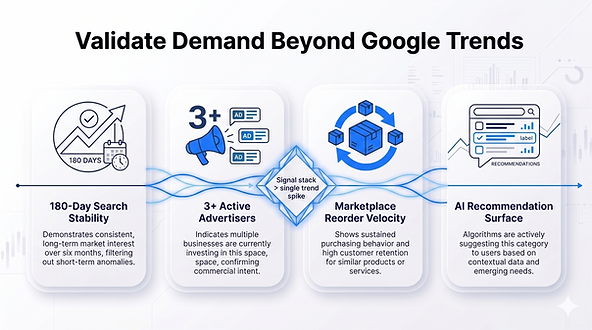
Signal 1: Search-demand steadiness over 180 days. Pull the product head term and three-to-five long-tail variants into Google Trends. What you want is not the highest line. It is the steadiest line. Year-over-year stability beats sharp spikes. Spikes are TikTok fads; stability is search-intent demand. This step alone disqualifies maybe 60% of “trending” candidates.
Signal 2: Ad-library presence across at least three independent sellers. Use Meta Ad Library and tools like Minea or Sell The Trend to confirm that more than one operator has been advertising the product for more than 60 days. One advertiser is an experiment. Three or more advertising consistently means there is real demand absorbing the spend. Beware of clusters that all started ads in the same week — that is the spread of a trending TikTok trend, not a stable category.
Signal 3: Marketplace reorder velocity. Check the product’s velocity on Amazon, Walmart Marketplace, or eBay using Helium 10, Jungle Scout, or Zonebase-equivalent tools. Reorder velocity — not new-listing velocity — is the truer signal. A product with 1,200 monthly Amazon orders from a five-year-old listing is more validated than the same product with 1,200 monthly orders from a three-month-old listing. The first has cleared returns and reviews; the second has not.
Signal 4: AI-recommendation surface check. Newer in 2026, but increasingly necessary. Ask ChatGPT, Perplexity, and Claude to recommend the top three products in the category and see which SKUs and which sellers surface. If your candidate product never appears in the AI recommendations — and your candidate supplier or brand does not appear either — you are entering a category where someone else has already built the structured-data depth and review density that LLMs are weighing on. That is not a disqualification. It is information about how much harder the differentiation lift will be.
These four signals don’t cost much to check. Used together, they help you weed out most weak products before you spend money on inventory or ads.
The product-supplier fit problem that breaks half of new SKU launches
A product is only as good as the supplier that ships it. This sounds obvious. In practice, half of new-SKU launches fail not because the product was wrong but because the supplier-product fit was wrong. Three failure modes recur often enough to be patterns.
The first is a catalog supplier on a hero product. Catalog suppliers — large dropship marketplaces with 100,000+ SKUs — are excellent for testing. They are designed for breadth, not depth. When you find a winner and try to scale it through the same catalog supplier, you discover that the product has eight other sellers behind it, that pricing power is gone within two weeks, that QC is whatever the underlying factory ships, and that the supplier has no incentive to defend your specific SKU’s reputation. Hero products need direct supplier relationships, not catalog ones.
The second is a direct factory on a low-velocity product. The opposite mistake. Bargaining directly with a Chinese factory for a product that does 30 orders a month means you are using a heavyweight relationship for a featherweight product. The MOQ economics will be against you, the communication overhead will be against you, and the supplier will quietly deprioritize you against their larger clients. Low-velocity products belong in catalog or hub relationships; high-velocity SKUs deserve direct ones.
The third is single-supplier dependency on a peak-season product. Going into Q4 with one supplier on a product that drives 30%+ of holiday revenue is a specific kind of operational risk. Suppliers run out of stock, have customs holds, miss SLAs, lose key staff, get raided, or simply stop returning messages. Mature operators carry secondary supplier relationships on every Q4 hero product, even if 80% of volume routes to the primary. The cost of redundancy is small. The cost of not having it during a peak week is operationally catastrophic.
The solution for all three issues is to treat the supplier-product relationship as a careful choice. Not every SKU needs the same type of supplier. Make sure the supplier’s capabilities fit the product’s needs, rather than forcing products to fit the supplier.
Proven Fulfillment Partner, FFOrder
You don’t need FFOrder to use the framework above. The five economic tests, the profile map, the four validation signals, and the supplier-fit approach work no matter where you source your products—whether it’s a US catalog, a private agent in Yiwu, an Alibaba Verified factory, or a marketplace plugin.
Where FFOrder enters is for operators who reach Profile B or Profile D — mid-ticket considered purchases or branded private-label SKUs — and want a single supply layer that can carry hero SKUs at scale without the catalog-supplier fragility. The sourcing network of 40,000+ verified factories handles breadth; direct procurement from a 25-person team handles depth on hero products; multi-hub fulfillment in Zhengzhou, Shenzhen, and Yiwu processes around 50,000 orders per day with 60% automation; 99.8% delivery success rate across 100+ international routes covers the operational tail; OEM, ODM, and POD with low MOQ supports the migration from generic listings to branded SKUs that the AI-discovery shift is now rewarding. Roughly 110,000 corporate clients use this stack today — the operational density that makes dedicated routes survivable instead of consolidator-dependent.
The rIt’s better to see this as a portfolio decision, not just a procurement choice. If your top SKUs are still with a catalog supplier, the real question isn’t if you should switch, but when the cost of staying becomes higher than the hassle of moving. frequently asked questions.
FAQ
What are the best dropshipping products to sell in 2026?
The real answer is that it depends on your store’s profile, where your traffic comes from, and how mature your operations are. In 2026, popular categories include pet enrichment, wellness, vitamins and supplements, eco-friendly home goods, mid-tier electronics, beauty tools, and outdoor or cycling accessories. But the better question is which economic profile (A to E from the framework) fits your store, and which categories within that profile your audience already likes.
How did the Section 321 suspension change which products are profitable to dropship?
Materially. Before August 29, 2025, parcels under USD 800 from China entered the United States duty-free. After that date, full duties, IEEPA charges, and Section 301 tariffs apply. For low-ticket product (USD 8–30 retail) that previously ran 35–40% landed cost, the new effective landed cost can push past 50%, which collapses the contribution margin below the threshold needed to cover Meta or Facebook CAC. The fix is either to reprice (often unrealistic), nationalize inventory into a US 3PL footprint, source through a supplier that prices DDP-inclusive, or migrate the catalog toward higher-ticket SKUs where the duty hit is a smaller percentage of retail.
What is a healthy profit margin for dropshipping products in 2026?
Healthy ranges quoted by 2026 industry sources cluster as follows: gross margin 15–40%, net margin 10–30%, with 20%+ net margin considered strong. High-ticket dropshipping can sustain 15–25% net margin profitably because the absolute dollars per order are larger. Low-ticket dropshipping needs 30%+ net margin to absorb returns, fees, and customer acquisition costs. Below 10% net margin, the model is fragile against any one of return-rate spikes, tariff changes, or CAC increases.
How do I find winning dropshipping products without paying for expensive tools?
A disciplined free stack: Google Trends for 180-day demand stability, Meta Ad Library for advertiser presence, Amazon best-seller and movers-and-shakers pages for marketplace velocity, AliExpress and Alibaba supplier cross-checks for sourceability, and ChatGPT or Perplexity for AI-recommendation surface checks. Paid tools (Minea, Sell The Trend, Helium 10, Zik Analytics) accelerate the process but do not change the fundamental signal logic.
Are high-ticket dropshipping products better than low-ticket ones in 2026?
There’s no one-size-fits-all answer. In 2026, high-ticket products are generally easier to run profitably because duties have less impact, AI discovery favors bigger purchases, and higher customer value covers higher ad costs. Low-ticket products can still work if you have a strong basket-building strategy and US-based inventory, but it’s harder than it was in 2023. Many operators who started with low-ticket items are now adding more mid- and high-ticket products instead of replacing their whole catalog..
How many products should I have in my dropshipping store?
For a niche store, having 30 to 120 SKUs usually works better than having over 1,000. For a general store, you can have thousands of SKUs, but only if you have the right infrastructure. What matters more than SKU count is how concentrated your sales are. If your top 10 SKUs make up less than 60% of your revenue, your catalog might be too broad. If they make up more than 90%, your catalog might be too risky and not diverse enough.
Can private-label dropshipping work without large MOQ commitments?
In 2026, yes, but only with sourcing partners structured for low-MOQ private-label work. POD (print-on-demand) handles low MOQ natively. ODM and OEM increasingly offer MOQs in the 50–500 unit range for sellers with proven sales history, versus the 1,000–5,000 unit historical floor. The economic case for migrating winners from generic to branded is stronger now than at any point in the prior five years, primarily because LLM-discovery weights branded SKUs higher and review density compounds faster on branded listings.
How do I know whether a trending product is a real opportunity or a fad?
Here’s a quick test: Was there demand for the product 180 days ago, and will there likely be demand 180 days from now? If yes to both, treat it as inventory. If no to both, only use your test budget. If only one answer is yes, treat it as a short-term, seasonal product and don’t invest in extra infrastructure. Most products that go viral on TikTok don’t pass this 180-day test, which is why successful operators rarely build their catalogs around viral hits.
Final Thoughts
You’ll keep seeing “top 25 winning dropshipping products in 2026” lists. They’re helpful, like real estate listings—not because you should buy every item, but because reading them helps you understand the market. The mistake is treating these lists as a shopping guide instead of a way to sharpen your instincts.
A better approach is to run each product on the next list you see through the five economic tests. Check if the SKU can hit a 25% contribution margin with 2026 costs, if its profile fits your store’s traffic and basket size, and if the supplier can handle the volume you’d need. Most products won’t pass all these tests for your situation, but that just helps you find the two or three that are worth testing this quarter.
The operators who succeeded after 2025 weren’t the ones who found the perfect product list. They were the ones who got better at filtering any list quickly. There’s no shortcut—just the discipline to apply the filter every time.
If your next ten SKUs perform better than your last ten, the framework is working. If not, the issue is usually with your supplier choice, how you validate demand, or your margin calculations—not the product itself. Good results come from good decisions, so focus most on those choices.
Further reading on adjacent operator decisions: how the supplier layer behaves at scale is covered in Scaling Dropshipping: Why Most Stores Hit a Wall at 200 Orders a Day; platform-side architecture for WooCommerce operators specifically is covered in Why WooCommerce Dropshipping Feels Different in 2026; and the operational profile of the supply layer that supports Profile B and Profile D catalogs is at FFOrder Dropshipping Solutions. For operators considering whether the migration from catalog supplier to direct supply is the right next move, the company background is the practical place to start a conversation.
FFOrder Team
FFOrder helps growing brands run dropshipping and fulfillment as one system — from sourcing across 40,000+ factories to global shipping and structured after-sales.
Ready to source dropshipping products that actually clear the margin tests?
FFOrder gives you DDP-included pricing, scalable supplier capacity, and US 3PL fulfillment—so your next ten SKUs survive the post-Section 321 math.
-1200x628%20(14).png)