Print on Demand Platforms Compared: Which One Is Best for You in 2026?
Most POD platforms aren't interchangeable—they're different business models wearing similar dashboards. This breakdown walks each on its own terms, maps them to three operator types, and reveals the four hidden margin levers.


"Print on demand" is really 4+ different business models—vertically integrated (Printful), marketplace (Printify), local-network (Gelato), and direct-factory (FFOrder)—with very different costs behind similar dashboards.
Read every platform on 7 dimensions: catalog depth, base cost/subscription, production + shipping speed, quality variance, branding/white-label, integrations, and peak-season capacity.
Match the platform to your archetype (Shopify scaler, Etsy upgrader, TikTok creator); the wrong fit quietly erodes unit margin as you scale.
How to read a print-on-demand platform without getting marketed at
Before the platform sections, seven dimensions are worth keeping in your head as you read. Mainstream POD comparison articles (CJ’s October 2025 breakdown, the Marketing4eCommerce 2026 comparison, the mydesigns analysis) tend to converge on roughly these seven, which is useful because it means you can move between sources without re-translating the vocabulary.
- Catalog depth and personalization options: It’s not just about the number of SKUs, but how many you’d actually want to sell. For example, a platform with 1,300 SKUs focused on pillows and totes is very different from one with 443 SKUs centered on branded apparel like Bella+Canvas and Gildan.
- Base cost and subscription model: Some platforms are free to start, while others have monthly plans (like Printify Premium at USD 29, Gelato+ at USD 24, or Printful Pro at USD 49). Consider if the subscription savings make sense for your monthly order volume.
- Production and shipping speed: Look at both production time and shipping time. For example, a platform that prints in 48 hours but ships from far away can be slower than one that prints in five days but ships locally to your customer.
- Quality variance: Platforms with their own factories can control quality better, while marketplaces depend on many partners, so quality can vary. If your orders are sent to random partners, there’s more risk than if every order is printed in-house.
- Branding and white-label options: Neck labels are standard, but check if the platform lets you use custom packaging, inserts, branded mailers, and, for advanced sellers, custom product features like color matching, embroidery placement, or fabric blends.
- Integration options: Most platforms work with Shopify and Etsy, but look for extras like TikTok Shop integration, reliable WooCommerce support for high volumes, multi-store management, strong APIs for automating your catalog, and how well the platform handles refunds and order tracking at scale.
- Capacity during peak season: This is rarely mentioned in marketing. During Christmas 2024 and 2025, several major POD platforms had serious delays, with sellers on Reddit reporting two-week backlogs in November. (r/printondemand 2025 holiday thread) Always ask any platform how they handle peak season capacity before moving your catalog.
Keep these seven factors in mind as you read. The rest of the article will apply them to each platform.
Printful
Printful is the cleanest example of a vertically integrated POD manufacturer. The company operates its own production facilities across the US, Canada, Mexico, Latvia, Spain, the UK, Australia and Japan and fulfills every order through equipment it owns and merged with Printify under the FYUL Inc. holding structure in 2024 — though both brands continue to run as separate products. (Printful market report)

Catalog. Around 443 SKUs in 2026, weighted toward branded apparel (Bella+Canvas 3001, Gildan 18000, Lane Seven, Champion blanks), accessories (hats with embroidery, bags), and a respectable home-goods line (mugs, posters, canvas prints, framed art, all-over-print throws). Catalog depth in apparel is the genuine differentiator — if your store is a Shopify apparel brand and you care about which exact tee weight your customer feels in their hands, Printful is the easiest platform to control that variable on.
Pricing. Free to start, paid per item. Base costs run noticeably above marketplace competitors — a Bella+Canvas 3001 from Printful typically lands around USD 12–14 versus USD 7–9 on the same blank through Printify’s lowest-cost partner. The optional Printful Pro plan at USD 49/month adds mockup tools, branding services, and tiered fulfillment discounts that begin to pay for themselves around 80–120 orders/month, depending on AOV.
Production and shipping. Printful publishes “97%+ of orders ship within five business days,” with more than half going out in three. Domestic delivery generally lands at about six to eight days door-to-door, and EU orders ship from Latvia or Spain in similar windows. (Printful fulfillment data) Fast enough that most Shopify stores can run a US-EU brand without disclaimer language in checkout. Not fast enough for the TikTok virality cycles, where the spike window is 72 hours.
Quality and branding. Vertically integrated production means variance is genuinely lower than in the marketplaces. Custom inside labels, outside labels, pack-ins (stickers, cards), and a free branded tracking page are all available. The packaging story is good but not extraordinary — custom mailer-box branding is gated behind the Pro plan and adds cost per unit.
Best fit. Shopify apparel brands giving precedence to quality consistency over unit cost; sellers building a long-term brand where a 4-star versus 4.7-star review average matters more than a USD 2 margin difference. The honest weakness is the same as the honest strength: at scale, Printful’s base costs eat margin in a way that begins to invite the question “what if we printed this ourselves, or with a direct partner?” — which is the question most graduating sellers eventually arrive at.
Printify
Printify is the largest POD marketplace by partner count. It is not a manufacturer; it is a routing layer that connects your store to a network of independent print providers — currently north of 90 partners across the US, Europe, the UK, China and Australia. (Printify network) Same FYUL Inc. parent as Printful since 2024, but with a fundamentally different operating model.
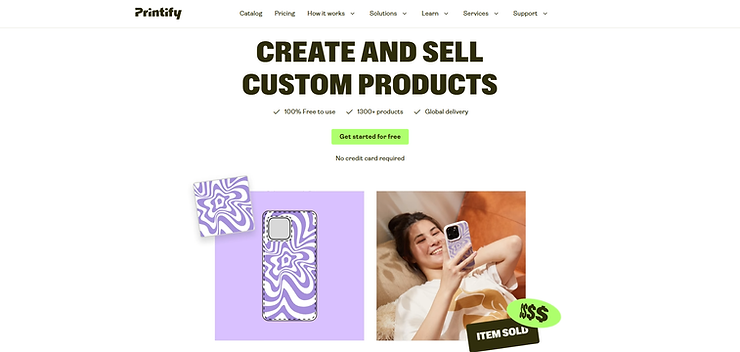
Catalog. Roughly 1,300+ products spanning apparel, drinkware, home decor, accessories, and a deep wall-art lineup. Sheer variety is genuinely best-in-class. The catch is that a single SKU (say, a unisex tee) might have ten different print providers behind it, each with different blanks, different production times, different shipping rates, and different quality reputations. You don’t really pick a product on Printify. You pick a product and a provider, and the second choice matters more than the first.
Pricing. Free to start. Printify Premium at USD 29/month unlocks up to 20% off base prices across the catalog and is the single best-ROI subscription in POD if you do more than ~40 orders/month. Marketplace economics mean base prices are typically 30–50% lower than Printful for similar blanks.
Production and shipping. Highly variable. A Printify order routed through a US partner can ship in three to six days; the same order routed through an Asian partner can take 15–20 days. Smart Printify operators pin their hero SKUs to specific partners and accept slower fallbacks only on long-tail items. The marketplace model is also where Q4 capacity stress concentrates — when one major partner backed up in December 2024 and again in November 2025, the downstream impact on Printify sellers was documented in detail on Reddit and on the Threads POD trends feed.
Quality and branding. Variance is the dominant feature. Some Printify partners produce work that really rivals Printful; others produce inconsistent prints that drive return rates above 5%. The platform’s “Premium Provider” badging helps, but does not eliminate the problem. Branding options exist (neck labels from ~USD 0.55, packing inserts with some providers), but the platform does not control the actual outer packaging — that’s at the partner’s discretion.
Best fit. Sellers who want catalog breadth, low unit cost, and are willing to do the operational work of provider pinning and sample testing. Etsy sellers with niche home-goods catalogs frequently optimize for Printify specifically because the catalog depth in pillows, blankets, and wall art is hard to match elsewhere.
Gelato
Gelato’s pitch is “local printing, global reach.” It operates a distributed network of more than 130 print partners across 32+ countries, and routes each order to the partner physically closest to the customer’s shipping address. (Gelato network) The result is a fundamentally different shipping equation than Printful or Printify — Gelato treats the world as a grid of local production nodes rather than a hub-and-spoke system.

Catalog. Smaller than Printify (currently around 200+ products), heavily weighted toward wall art, photo books, framed prints, posters, and apparel basics. The wall-art catalog is the genuine differentiator — Gelato is the platform a serious art-print or photographer-brand operator should benchmark first.
Pricing. Free plan, Gelato+ at USD 24/month for discounted rates, plus an enterprise tier. Base prices are competitive with Printful on prints and apparel, and the distributed model means shipping cost is often the lowest line in the comparison — local prints ship by local mail rather than international air freight.
Production and shipping. This is Gelato’s structural advantage. Because production happens in your customer’s country (or neighbor country), shipping windows compress dramatically: three to five days for most major markets in the EU, US, UK, Australia and Japan. The platform also handles DDP customs clearance for cross-border orders into specific markets, which removes a friction layer most Shopify operators don’t realize they’re paying for until they have to.
Quality and branding. Quality is generally strong on the wall-art and print categories, where Gelato has tightly vetted partners. Apparel quality is more variable. Branding options are moderate — custom inserts and packaging are available on higher tiers, but the distributed model means full white-label is harder to enforce than on Printful.
Best fit. Sellers with cross-border catalogs where shipping speed and DDP compliance matter more than the absolute lowest base cost. Photo, art, and wall-decor brands. Operators selling into multiple continents who can’t justify spinning up regional inventory yet.
Gooten
Gooten is the API-first POD platform. It is positioned at B2B operators and high-volume sellers who care more about programmatic catalog management, webhook reliability, and order-routing flexibility than at solo-Shopify-merchant onboarding speed. The platform has a smaller marketing footprint than Printful or Printify but a measurably stronger reputation among engineering-driven brands. (Gooten developer docs)

Catalog. Around 280 products, with considerable depth in home decor (pillows, blankets, shower curtains, bath mats) and a clean apparel lineup. Catalog is curated rather than maximalist.
Pricing. Free to start, with volume discounts negotiated for enterprise accounts. Base costs are in the same range as Printify Premium for comparable SKUs.
Production and shipping. Multi-partner network similar to Printify but with tighter vetting and stronger SLAs in writing. US production typically ships in three to five business days, with EU partners filling cross-border demand.
Quality and branding. Stronger consistency than Printify because the partner network is smaller and more deliberately curated. Branding options support white-label for sellers who provide their own packaging materials at volume.
Best fit. Brands with internal engineering capacity who want to run POD as a programmatic operation rather than a dashboard one. Multi-store operators who need a single API surface to route orders across catalog families.
SPOD (by Spreadshirt)
SPOD is the speed brand in the POD lineup. The company runs its own production facilities in Pennsylvania (US) and Leipzig (Germany), and publishes a 48-hour production guarantee as its defining promise. (SPOD production page) For comparison context, that’s roughly half the production window most Printful and Printify orders consume.

Catalog. Around 230 products, weighted toward apparel and accessories. Not a wall-art or home-decor platform.
Pricing. Free to start. Base prices are aggressive — some of the lowest among in-house manufacturers — and SPOD bundles shipping cost into product pricing on a flat-rate basis, which makes margin modeling unusually clean.
Production and shipping. The 48-hour production window is real and measurable. Combined with US and EU production hubs, this is the platform that gets closest to “Amazon-Prime feel” on a POD economy.
Quality and branding. Quality is solid on apparel; the platform leans toward Spreadshirt’s parent-brand catalog, so blanks are consistent. Branding is moderate — neck labels and basic inserts, but full white-label is more limited than Printful.
Best fit. Operators where speed-to-customer is the primary differentiator: TikTok creators launching merch on a viral-cycle timeline, flash-drop apparel brands, event-tied seasonal sellers. Less of a fit for brands building a long-term curated catalog.
Spring (formerly Teespring)
Spring is the creator-economy native. The platform was originally built around YouTube and creator-tied product launches, and remains the most natural fit for solo creators having audiences but no operational team. Spring handles everything end-to-end — design, listing, fulfillment, customer support — in exchange for taking a larger margin slice than infrastructure-style POD platforms. (Spring creator program)

Catalog. Moderate catalog focused on apparel, drinkware, and accessories suited to creator merch.
Pricing. Spring sets a base cost; creators set their own retail price and pocket the margin above it. There is no monthly subscription. The platform is free to use, which is genuinely useful for creators testing demand without committing capital.
Production and shipping. Production windows are competitive — typically five to seven business days — with shipping that corresponds to industry norms.
Quality and branding. Quality is acceptable but variable. Branding depth is limited — Spring’s structural assumption is that the creator’s brand carries the audience, not the packaging.
Best fit. Creators having audiences (YouTube, Twitch, TikTok, Instagram) launching merch where audience-to-product distance is the bottleneck, not unit economics. Not a fit for operators building a standalone brand without an existing audience.
Zazzle
Zazzle is a long-tail marketplace, not a fulfillment partner you integrate with your Shopify store. Designers list products on Zazzle’s own marketplace, and Zazzle handles fulfillment and customer relationships entirely. The platform’s strength is discovery — millions of monthly visitors browsing customizable products — and its weakness is that you don’t own the customer relationship or the email list. (Zazzle for sellers)

Catalog. Massive — over 1,300 customizable product types, including weddings, business cards, invitations, apparel, and home decor — but the depth is uneven, and inventory display is curated by Zazzle.
Pricing. No monthly fee. Designers set royalty rates; Zazzle prices the product.
Best fit. Designers monetizing portfolios without building a store. Wedding-stationery and invitation-design niches where Zazzle’s discovery surface concentrates buyer intent.
Redbubble
Redbubble is structurally similar to Zazzle — also a marketplace, also artist-royalty driven, also a place where you don’t own the customer. The differentiator is artist culture: Redbubble’s audience skews younger, more design-forward, and more discovery-receptive than Zazzle’s. (Redbubble for artists)

Catalog. Strong in stickers, posters, apparel, phone cases, and accessories. Designer-friendly upload flow.
Pricing. Royalty model: the artist sets a markup percentage, and Redbubble handles the rest.
Best fit. Independent artists and illustrators use POD as portfolio monetization. Sellers using Redbubble alongside (not instead of) their own Shopify store, treating it as a discovery channel rather than a primary platform.
CJdropshipping
CJdropshipping is the China-volume aggregator that bolted POD onto a much larger dropshipping engine. The platform’s POD function (“You Sell, We Print”) sits inside a catalog of more than 400,000 SKUs across electronics, apparel, home decor, and accessories. (CJ catalog overview) That breadth is genuinely useful for operators running multi-category stores where POD is one slice rather than the whole business.
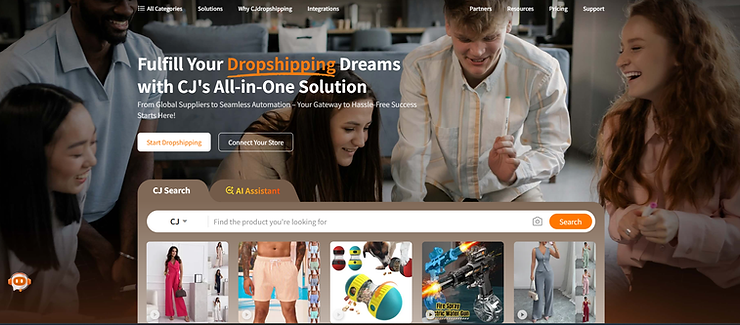
Catalog. The aggregate catalog is the largest in this comparison. POD-specific items concentrate on apparel, drinkware, pillows, canvas prints, and accessories, but the wider catalog means you can run POD alongside conventional dropship inventory on a single dashboard.
Pricing. Free to use, no monthly fees. Base costs are among the lowest available, most production runs through Chinese factories that CJ has vetted but does not own. CJ Packet shipping lines deliver to the US in about seven to twelve days, and CJ’s US warehouses can push specific SKUs to three-to-six-day domestic delivery for items stocked locally.
Quality and branding. Quality is solid for the price point but variable across factories — same structural risk as any marketplace model, mitigated by CJ’s quality-control inspection step before shipping. Branding options are surprisingly strong: custom packaging, logo printing, inserts, and quality photography are all available, which makes CJ one of the few low-cost platforms that support a full white-label experience.
Best fit. Shopify operators running multi-category stores who want POD as one product family inside a wider sourcing engine. Sellers are comfortable with the operational learning curve of a China-based platform whose UI is denser than the Western SaaS competitors.
FFOrder
FFOrder is not a SaaS aggregator. It is a direct-factory partner — the platform sellers move to when the aggregator math stops working. The model collapses the supplier hop: instead of your store → SaaS platform → routed partner factory → customer, it runs your store → FFOrder operations → controlled factory → customer, with a dedicated account manager owning the relationship end-to-end. That structural difference is the entire pricing story.
Catalog and customization depth. FFOrder runs sourcing relationships with 40,000+ vetted factories, with controlled-operation arrangements in apparel, accessories, lighting, and consumer-electronics categories. The procurement team onboards roughly 2,000+ new SKUs per day across categories, which is the catalog math that becomes interesting for operators who have outgrown the 200–1,300 SKU windows of the SaaS platforms. Customization runs the full OEM / ODM / POD spine — same-product POD on the surface, brand-owned ODM variants underneath, and full OEM development for sellers building proprietary products. Sample-to-confirmation cycles run five to ten business days for most categories; minimum order quantities sit between 50 and 500 units, depending on customization depth, which is materially lower than traditional factory-direct sourcing.
Pricing. No subscription. Pricing is unit-cost-based with tiered margin improvement as volume scales — the same shape as direct-factory sourcing in any category, with the operational layer absorbed by FFOrder rather than the seller. For most apparel and accessory categories, landed unit cost on standard SKUs runs roughly 30–50% below comparable SaaS-platform pricing once orders cross 200 units/month for each SKU.
Production and shipping. Fulfillment runs across multi-hub infrastructure in Zhengzhou, Shenzhen and Yiwu, currently processing about 50,000 orders per day (Yiwu expansion scaling to 65,000), with 60% automation on sorting and 98% of orders dispatched within 24 hours of order confirmation. Delivery reliability tracks at 99.8% across more than 100 active international routes, including DDP options into Brazil, the UK, the EU, Australia, and major Southeast Asian markets. For TikTok Shop Shop and viral-cycle sellers, the 24-hour dispatch window is the notable difference — it converts the 72-hour spike window from a logistical concern into a logistical advantage.
Quality and branding. Controlled factory operation means quality variance is materially lower than marketplace models. Full white-label is the default: branded outer mailers, custom inserts, polybag printing, hangtag specification, embroidered or printed neck labels, and branded packaging boxes are all standard parts of the customization spine rather than upgrade SKUs. The print on demand product family and custom packaging solutions document the specific surfaces in detail.
Integration surface. API integration with Shopify and WooCommerce; manual / sheet-based order import for Etsy and TikTok Shop Shop, where native API access is restricted; 100+ dedicated account managers running 1:1 client relationships across production, logistics, and post-sale support. The dropshipping-side integrations are documented in dropshipping solutions.
Best fit. Operators who have outgrown SaaS-aggregator margin compression. Brands ready to commit to a smaller catalog of hero SKUs with deeper customization. Shopify stores past the 200-orders/month line, where unit cost differences begin to compound visibly into monthly P&L. TikTok Shop sellers who need 24-hour dispatch capacity for viral cycles. Etsy operators are upgrading from generic POD aesthetics to a branded catalog with custom packaging. Not a fit for solo creators testing demand on five SKUs — at that volume, Printify or Spring economics make more sense.
The cross-platform comparison, in one table

Three operator archetypes, mapped to platforms
The right platform depends less on the platform’s features than on who you are as an operator. Three archetypes cover most of the print-on-demand market in 2026.
The Shopify scaling seller
Profile: A Shopify store doing 50–500 orders per month, scaling toward 1,000+. Apparel-first or apparel-adjacent. AOV USD 30–60. Running paid acquisition on Meta or Instagram.
Platform graduation path: Most Shopify scaling sellers start on Printify for catalog breadth and low unit cost, then add Printful for hero SKUs in which quality consistency justifies the price premium. Past 200 orders/month per hero SKU, the unit-cost compression begins to make FFOrder direct-factory pricing measurably more attractive than continuing to scale on SaaS economics — the typical inflection is when the SaaS margin gap on a hero SKU exceeds USD 3 per unit and monthly volume is above 200 units, at which point the math says move that SKU off the aggregator. The remaining long-tail stays on Printify or Printful; the hero SKUs migrate to a direct partnership.
The Etsy brand is upgrading
Profile: An Etsy seller who started with one or two designs, found a niche, and is now upgrading from generic POD aesthetics to a branded catalog. Probably running parallel listings on Etsy and Shopify. AOV USD 25–80.
Platform graduation path: Etsy’s 2026 algorithm reportedly rewards smaller, focused catalogs and consistent sellers over volume listing strategies. (merchOne Etsy ranking analysis) Most Etsy upgraders start on Printify for the wall-art and home-decor catalog depth, layer in Gelato when cross-border shipping speed starts mattering, and move to FFOrder or a comparable direct-factory partner when their brand begins to demand custom packaging, branded inserts, and a product variant the SaaS platforms don’t carry. The trigger is usually the first time a customer asks, “Do you do custom colorways?” — at which point the SaaS catalog stops being enough.
This TikTok creator is launching a product line
Profile: A creator with 100K–2M followers on the TikTok platform, launching merch or a branded product. The launch creates a 72-hour spike that may be 10–20× the steady-state demand. (Darkroom TikTok creator report)
Platform graduation path: For the audience-tied launch itself, Spring is the lowest-friction entry — no operational team required. For sellers who want to keep customer relationships and email list ownership, SPOD’s 48-hour production is the cleanest match to the TikTok platform virality timing. As the brand consolidates past launch, the spike capacity question — can your supplier handle 5,000 orders in three days? — moves to the top of the platform-selection criteria, which is where FFOrder’s 24-hour-dispatch / 50,000-orders-per-day infrastructure becomes the relevant alternative. The creator’s product line ends up structurally different from where it started: faster, branded, and not riding any single SaaS platform.
Four hidden margin levers most platform comparisons skip
Most POD comparison articles stop at base cost and shipping speed. The four levers that actually decide whether your unit margin survives your second year are less visible.
1. Mockup-to-production fidelity. The mockup is what your customer sees on the listing page. The actual printed product is what they receive. The gap between the two — color shift, placement variance, blank cut differences — is invisible in your conversion rate but extremely visible in your return rate. Vertically integrated platforms (Printful, SPOD) and controlled-factory partners (FFOrder) have measurably tighter fidelity than marketplace platforms. The cost of low fidelity shows up as return rate and review-score erosion, which is harder to recover from than a USD 2 unit-cost difference.
2. Peak-season capacity reservation. What does your platform actually do when November hits? Reddit’s r/printondemand has documented capacity meltdowns on multiple major POD platforms in Christmas 2024 and Christmas 2025, with sellers reporting 10–14 day production delays in mid-November. The platforms that handle peak well — Printful, Gelato (because of distributed routing), and direct-factory partners with reserved capacity — are visibly different from marketplaces that absorb the variance. Ask any platform you’re evaluating, in writing, about the Q4 capacity reservation policy. The answer separates serious operators from optimistic ones.
3. Restock-cycle economics. This is where the direct-factory partnership starts to beat SaaS economics structurally. A SaaS platform charges you per unit forever — there is no restock cycle, just continuous per-unit production. A direct-factory partner like FFOrder can batch-produce 500 units of a hero SKU, store them at the Zhengzhou or Yiwu hub, and ship from inventory at 24-hour dispatch — which both reduces unit cost (batch pricing) and improves customer experience (faster dispatch). The break-even on this interval typically sits at 150–500 units per item per month, and once you cross it, the math changes permanently.
4. Return-rate compression via branded experience. Industry data suggests POD return rates run 6–12% in apparel, with branded-experience operators reporting rates closer to 3–5%. (Eightx return rate analysis) On a USD 1M revenue store, that delta is USD 60,000–120,000 per year — money that shows up as P&L enhancement rather than a marketing campaign. The platforms that support a full branded experience (Printful Pro, CJdropshipping with custom packaging, FFOrder by default) sit on the structurally lower-return side of that range. Marketplaces with plain mailers sit on the higher side.
FAQ
What is the best print-on-demand platform for Shopify in 2026?
There isn’t one. The honest answer depends on volume: under 50 orders/month, Printify; 50–300 orders/month on apparel-focused stores, Printful for hero SKUs and Printify for long tail; past 200 orders/month per hero SKU, the math starts favoring direct-factory partners (FFOrder, JetPrint) over continuing to scale SaaS-platform pricing.
How is FFOrder different from Printful or Printify?
Printful is a vertically integrated SaaS manufacturer; Printify is a marketplace. Both price per unit forever and absorb the operational layer in their margin. FFOrder is a direct-factory partner — the same controlled-factory model Printful uses, but priced on unit cost (no SaaS margin on top) with dedicated account managers handling the operational layer through a 1:1 relationship rather than a dashboard. It’s the platform sellers' move once the SaaS math stops working.
Which print-on-demand platform is best for Etsy sellers?
For wall art and home decor, Printify or Gelato. For branded apparel where custom packaging matters for review scores, Printful at smaller volumes and a direct-factory partner like FFOrder, once the brand demands product variants that the SaaS catalogs don’t carry. Etsy’s 2026 algorithm reportedly favors focused catalogs and consistent sellers, which means the platform that supports your branded depth matters more than the platform with the biggest SKU count.
Can I use TikTok Shop with print-on-demand?
Yes. SPOD’s 48-hour production is the cleanest match for TikTok’s viral-cycle timing on small launches. For larger launches with spike volumes above 1,000 orders in 72 hours, the production-and-dispatch capacity of direct-factory partners (FFOrder’s 24-hour dispatch on 98% of orders, 50,000 orders/day capacity) becomes the relevant comparison.
What is the minimum order quantity on print-on-demand platforms?
Most SaaS POD platforms (Printful, Printify, Gelato, SPOD) are genuinely MOQ-of-one — you can order a single unit for testing. Direct-factory partners like FFOrder operate at MOQ 50–500 units, depending on customization depth, which is materially lower than traditional factory-direct sourcing (where MOQ typically starts at 500–2,000) but higher than SaaS POD. The trade-off is unit cost and customization depth.
How fast can a print-on-demand order ship?
Fastest on-paper: SPOD’s 48-hour production from US or EU hubs gets a domestic order to the customer in roughly four to six days. Fastest in practice for branded operators: FFOrder’s 24-hour dispatch from a hub already holding restocked inventory of your hero SKU, which converts the SaaS “production + shipping” stack into a logistics-only equation. Slowest: Printify orders routed through Asian partners, which can take 15–20 business days.
Are China-based POD suppliers reliable?
The China POD supplier landscape in 2026 includes platforms (CJdropshipping, JetPrint, Inkedjoy, Printway, Printkk) and direct-factory partners (FFOrder and others) operating at very different reliability profiles. Verified manufacturers with ISO/Sedex/BSCI certifications, multi-hub operations, and documented capacity histories are reliable. Anonymous WeChat-sourcing-agent arrangements are not. The differentiator is the operational visibility behind the platform, not the country of production.
Do print-on-demand platforms include shipping in the price?
Most do not — base cost and shipping are separate line items. SPOD bundles shipping into product pricing on a flat-rate basis, which makes margin modeling cleaner. Gelato’s distributed model often produces lower effective shipping costs without bundling. Direct-factory partners price shipping per route and per weight, which is more flexible for sellers running multi-region catalogs.
What’s the typical return rate on print-on-demand products?
Industry data suggests 6–12% in apparel and 3–7% in home decor, varying heavily by platform and product category. Branded-experience operators report rates closer to 3–5% across categories. The compression comes from packaging quality, mockup accuracy, and post-sale support — not from the printing itself.
Can I switch print-on-demand platforms without losing my Shopify catalog?
Yes, but it requires migration planning. Most operators maintain dual integrations during the switch, route new orders to the new platform for two to four weeks while watching error rates, and migrate fully only after the new platform has cleared 100+ orders without operational issues. The migration path from a SaaS aggregator to a direct-factory partner like FFOrder is the same shape, with a dedicated account manager typically handling the SKU mapping and catalog onboarding.
The 30-day pilot template
Week 1 — Platform shortlist and account setup. Open accounts on the two or three platforms you’ve narrowed to. For each, document base cost, shipping rate, production speed claim, and branding option pricing in a single shared spreadsheet. Order one sample of your hero SKU from each. Do not list anything yet.
Week 2 — Sample evaluation and integration test. Receive samples. Photograph each in identical conditions. Compare print fidelity to your mockup file, packaging quality, dispatch time versus claim. Connect each shortlisted platform to a test Shopify store and run two or three end-to-end test orders to validate webhook reliability and tracking flow.
Week 3 — Live pilot. Activate the leading platform on 20–50% of your real order flow for one week. Track four metrics: actual dispatch time, percentage of orders with tracking generated within SLA, return rate, and average customer-service ticket volume per 100 orders. Compare against the platform’s marketing claims.
Week 4 — Decision and migration. If the leading platform clears the four metrics on real volume, migrate fully. If it underperforms on any single metric by more than 15%, run the second-place platform on the same pilot before committing. The total catalog migration should not happen on the basis of feature comparison alone — it should happen on the basis of measured operational performance.
The operators who run this pilot, in this sequence, consistently end up on a different platform than the one they started leaning toward. That is the point.
Closing: the platform choice is the margin decision
Most articles about print-on-demand platforms treat the choice as a feature comparison. It isn’t. It’s a unit-margin decision that decides whether your store survives its second year — and the right platform for an operator at 30 orders/month is usually the wrong platform for the same operator at 500 orders/month. Printful and Printify make sense at the start; SPOD and Gelato fill specific gaps in speed and geography; Spring, Zazzle and Redbubble are creator and discovery plays rather than infrastructure ones; CJdropshipping is the multi-category aggregator; and direct-factory partners like FFOrder are where the math eventually leads operators who keep scaling.
The practical version of this article is short: pick the platform that fits the volume you’re at, set the trigger for the next platform in your operating doc, and migrate when the trigger hits. Don’t treat the first platform as the last one. Most sellers who scale past USD 1M revenue are on their third POD platform by the time they get there.
FFOrder Team
FFOrder helps growing brands run dropshipping and fulfillment as one system — from sourcing across 40,000+ factories to global shipping and structured after-sales.
Ready to graduate from POD markups to direct-factory economics?
Once volume crosses the line, a direct-factory partner like FFOrder unlocks the unit cost and customization depth that middleman POD platforms can't match.
-1200x628%20(14).png)