Dropship Supply Chain: The 2026 Playbook
A dropship supply chain moves a product from factory to doorstep without you holding inventory. This guide follows one order through all five hops—showing exactly where money and time leak, and what to ask before trusting any partner.

-1200x628.jpg)
A dropship supply chain spans five hops—storefront, sourcing, warehouse, cross-border logistics, last mile/after-sales—and you're only as strong as the weakest one.
Fragmented setups (one app per hop) are fine for validating a product, but the hand-offs become your growth ceiling once orders are repeatable.
Vet any partner with 5 questions—dispatch/delivery speed, real stock, branding at low MOQ, store sync, human support—and always order a sample first.
What a "Dropship Supply Chain" Actually Means
Most beginners picture one supplier on a marketplace. That is the costliest misunderstanding in e-commerce. As Shipware defines it, a dropship supply chain is a logistical model where the seller keeps no stock and passes each order to a third party — a manufacturer, wholesaler, or fulfillment center — that ships directly to the buyer. You own the storefront, the brand, and the customer relationship. The chain owns everything that happens after "Buy."
The important word is chain. A single order doesn't touch one supplier — it travels through a series of hand-offs, and a break at any one of them lands on you:
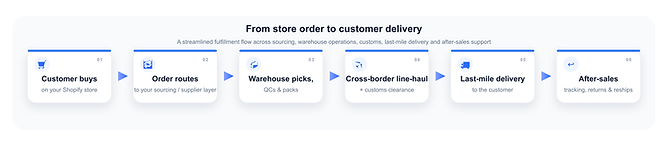
The customer never sees this diagram. They only see the result — a fast, intact, branded parcel, or a slow, generic, damaged one. Every link is a place where you either build trust or lose it.
Follow One Order: The Five Hops Where Money Is Won or Lost
Forget abstract layers. Watch what happens to a single order — a $39 product a customer just bought in Chicago — as it moves through the chain. Each hop is a point of leverage and a point of failure.
The storefront (order capture)
What happens: The order, address, and SKU are captured and need to flow cleanly to whoever fulfills it.
Where it breaks: Manual CSV exports and disconnected apps. If your store and your supplier aren't synced, you get delays, typos in addresses, and the silent killer — overselling a product that's already out of stock.
Sourcing (does the product even exist?)
What happens: The order hits the sourcing layer, which must have the item in real, verified stock.
Where it breaks: "Virtual" stock that backorders, factories of unknown quality, and no leverage on price. If sourcing is shallow, your best-selling SKU vanishes mid-campaign, and your ad spend burns against a product you can no longer ship.
The warehouse (pick, QC, pack)
What happens: The item is picked, quality-checked, and packed — ideally with your branding.
Where it breaks: Slow processing (the order sits for days before it ever moves), mis-picks, and generic packaging that keeps you forever replaceable. This is the hop beginners ignore, and brands obsess over.
Cross-border logistics (the make-or-break leg)
What happens: The parcel clears customs and travels to Chicago.
Where it breaks: This is the conversion killer. Shopify's own guidance is blunt that slow economy shipping (15–40 days) creates refunds and disputes. Lost parcels and surprise duties live here too. Speed on this single hop does more for your refund rate than any other optimization.
Last mile + after-sales
What happens: The parcel is delivered; tracking, returns, and any reship are handled.
Where it breaks: No tracking visibility, no clear returns process, and no human to fix problems. A customer with a silent, untrackable order is a chargeback waiting to happen.
The rule of the chain: a brilliant product (Hop 2) with 30-day shipping (Hop 4) still produces refunds. You are only as strong as your weakest hop — which is why optimizing one and disregarding the rest is why so many "winning products" quietly die.
The Hidden Tax of a Fragmented Supply Chain
When you stitch together a different vendor for each hop — one app for sourcing, another for shipping, a spreadsheet for tracking — you pay a tax that never shows up on an invoice. Shipware names the three failure modes precisely:
- You lose control of the experience. You never physically touch the product, so a supplier's bad packaging, wrong item, or delay becomes your 1-star review. Your reputation rests on a partner you can't see.
- You're blind to quality and stock. You can't QC what you never handle, and popular items "suddenly run out" — forcing you to refund and apologize for orders you already accepted.
- The multi-package problem. Source one customer's order from three suppliers, and they receive three parcels, at three times, with three tracking numbers — confusing buyers and flooding your inbox.
Mapped to what it actually costs you:
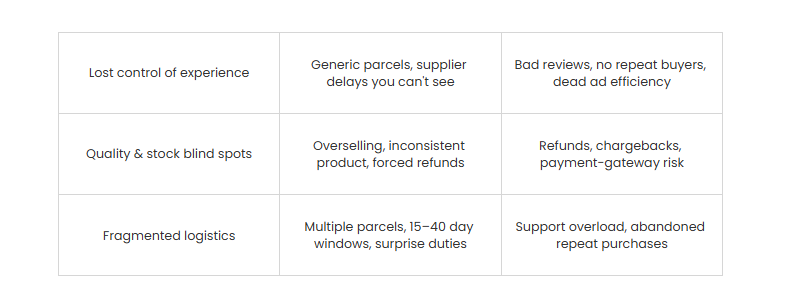
A fragmented setup is perfectly fine for one job: validating whether a product sells at all. The damage starts the moment you have repeatable, profitable orders, and the hand-offs between disconnected vendors become the ceiling on your growth — the exact problem we unpack in our guide to improving your ecommerce supply chain management.
A 90-Second Story: Same Product, Two Supply Chains
Two sellers launch the same $39 product to the same US audience.
Seller A runs a fragmented chain: a marketplace app for sourcing, whatever shipping the supplier defaults to, and tracking copied into a spreadsheet. Orders dispatch "in a few days," land in 25–30 days, arrive in plain poly bags. Refund rate climbs, reviews stall at 3.8 stars, and every scaling push just multiplies the support tickets. The store is busy but fragile.
Seller B runs an integrated chain: one partner handles verified sourcing, 24-hour dispatch, branded packaging, an express lane to the US, and live order sync with the store. Parcels land in about a week, looking like a real brand. Reviews compound, repeat purchases climb, and scaling ad spend doesn't break operations — it pays off.
Same product. Same ads. The supply chain is the entire difference. This is the gap that purpose-built partners exist to close. FFOrder, for instance, defines itself not as a dropshipping agent but as an integrated supply chain system — "we are not simply a dropshipping agent; we design and operate scalable supply systems that support lasting growth." Founded in 2017 and now serving 100,000+ sellers, it runs all five hops as one logic instead of fragmented steps. The lesson isn't "use this vendor" — it's that integration itself is the unlock once you're scaling.
The 5 Questions That Separate a Supplier From a dropship supply
Before you trust anyone with your brand, ask these five questions — and always order a sample first, because it's the only honest test of real delivery time and quality.
1. How fast do you actually dispatch — and how fast does it land?
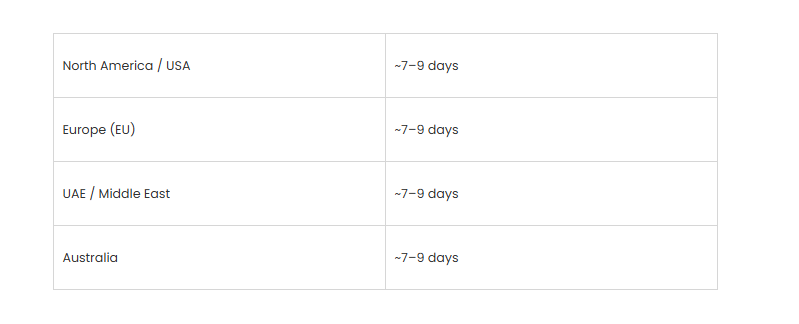
Dispatch speed and delivery window are different numbers, and you need both. "Good" means same-/next-day dispatch and a realistic express window to your core market. As a benchmark, an integrated partner like FFOrder reports 98% of orders dispatched within 24 hours across 100+ global routes, with a 99.8% delivery success rate:
2. Is the stock real?
Real, verified inventory — not virtual stock that backorders mid-campaign. Depth matters here: an integrated partner like FFOrder runs a 670K+ SKU library backed by 40,000+ factory partnerships, which is what gives you both product range and cost leverage.
3. Can you make it mine?
The difference between a store and a brand. Look for white-label shipping, custom packaging and inserts, and OEM / ODM / POD for your own products — crucially available at low MOQ so you can brand before you're doing huge volume.
4. Will it stay in sync with my store?
Native Shopify / API integration keeps inventory and tracking in sync (no manual uploads, no overselling) and gives you end-to-end visibility on every order. Operational maturity shows up in the metrics — for FFOrder, roughly 60% warehouse automation and near-100% picking accuracy at 50,000+ orders/day capacity.
5. Who picks up the phone when it breaks?
Every chain fails sometimes; good ones fail gracefully. Look for real human support and clear refund/reship SOPs — FFOrder, for example, assigns 1-on-1 VIP account managers with 24/7 service.
Dropship Supply Companies Worth Comparing in 2026
No two of these platforms are really competing for the same seller — they sit at different points on the curve from testing a product to building a brand. Here's how the most common dropship-supply options stack up on the things that actually matter (sourcing depth, shipping speed, branding, and integration), so you can match a partner to your stage rather than chasing the loudest ad.
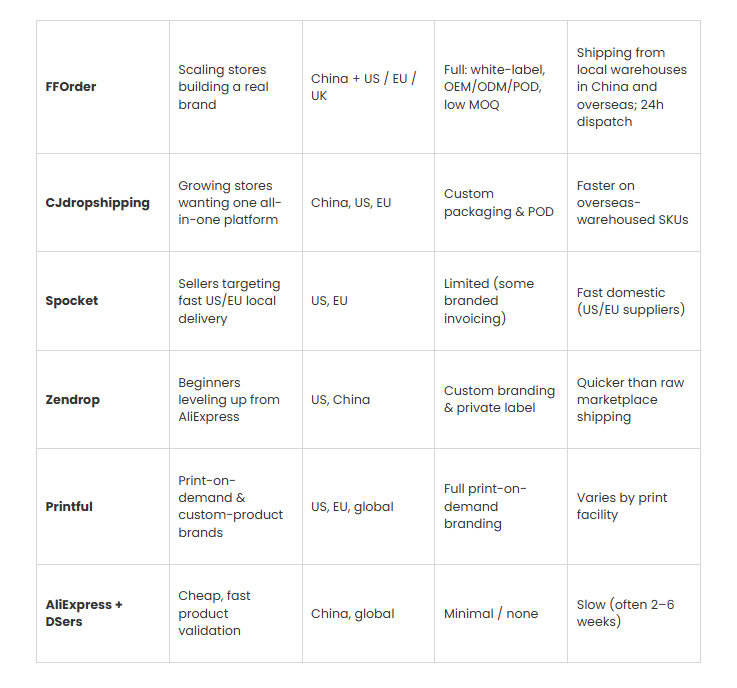
How to read this, by stage:
- Just validating a product? AliExpress via DSers is unbeatable for cheap, no-MOQ testing — just accept that slow shipping and zero branding cap how far it can take you.
- Want one platform that does a bit of everything? CJdropshipping is a solid all-rounder with overseas warehouses and basic customization, though beginners face a learning curve across its many modules.
- Selling mainly to the US or EU and want speed above all? Spocket leans on local suppliers for fast domestic delivery — at a higher product cost and with a thinner catalog.
- Is a beginner ready to look more professional? Zendrop adds branding and faster fulfillment on top of an AliExpress-style workflow.
- Building a custom-printed or POD brand? Printful is purpose-built for on-demand printing and merch.
- Scaling past validation toward a real, sellable brand? This is where an integrated supply chain like FFOrder's dropshipping fulfillment solution fits — it's built less like a product marketplace and more like an operating system across sourcing, warehousing, logistics, and support, with branding (OEM/ODM/POD) available at low MOQ and express lanes to major markets. For a deeper side-by-side, FFOrder's own 11 best dropshipping suppliers comparison breaks down delivery speed, MOQ, and automation across China, the US, and EU options.
The honest takeaway: there's no single "best" — there's the right fit for where you are now. Most successful stores start cheap and flexible to validate, then graduate to an integrated partner once orders are repeatable and a brand is worth protecting.
The Maturity Curve: From Reseller to Brand
Generic dropshipping has zero resale value — it's a website anyone can clone. A brand with repeat customers, unique packaging, and improved products is a real, sellable asset, and your supply chain is what carries you up the curve:
- Validate — cheap, flexible marketplace sourcing. Goal: prove a product sells.
- Optimize — faster fulfillment, accurate stock, better landed cost. Goal: make every order reliably profitable.
- Brand — custom packaging, white-label, and faster lanes. Goal: repeat customers and compounding reviews.
- Scale — private label (OEM/ODM/POD), multi-channel, buffer stock. Goal: defensible, sellable brand equity.
The through-line from Shopify's fulfillment guidance is consistent: businesses that last treat fulfillment as a strategy, not an afterthought. An integrated supply chain is what lets you climb these stages without rebuilding your back end each time — turning fragmented coordination into system-based execution, and uncertain fulfillment into predictable delivery.
FAQ
What is a dropship supply chain?
It's the end-to-end system that gets a product from the manufacturer to your customer without you holding inventory. It covers five jobs — sourcing, customization, warehousing, logistics, and tech/support. You market and sell; the supply chain stores, packs, ships, and supports.
How is a dropship supply chain different from a single supplier?
A single supplier is one link — usually sourcing. A real supply chain manages every link, including packing, shipping, customs, tracking, and after-sales. Relying on one disconnected supplier is why most stores hit a wall when they try to scale.
Why do most dropshipping stores fail in the supply chain?
They perfect the product and ads, but leave fulfillment fragmented. Slow shipping (15–40 days), inconsistent quality, and stock-sync errors create the refunds, chargebacks, and bad reviews that quietly kill otherwise-winning products.
Fragmented vs. integrated supply chain — which should I use?
Use a fragmented, marketplace-app setup to validate products cheaply. Once you have repeatable, profitable orders, move to an integrated partner that combines sourcing, warehousing, logistics, and support — it's faster, more reliable, and lets you brand.
How fast should dropshipping delivery be in 2026?
Buyers expect days, not weeks. With an integrated partner and express lanes, roughly 7–9 days to major markets (US, EU, UAE, Australia) is achievable; economy cross-border shipping of 15–40 days is too slow for most customers.
Can I add my own branding with a dropship supply chain?
Yes. With white-label shipping, custom packaging, and OEM/ODM/POD — ideally at low MOQ — you can ship branded orders without holding inventory. That's the bridge from a generic store to a defensible brand.
The Bottom Line
In 2026, your product gets you into the game — your dropship supply chain is what lets you win it. Trace your own orders through all five hops and find the weakest one, because that's the hop quietly capping your growth. Validate with a flexible setup, then graduate to an integrated supply chain the moment volume justifies it: predictable sourcing, fast fulfillment, and brand-ready packaging are what turn a fragile store into a scalable business.
When fragmented vendors start capping your growth, an integrated supply chain partner is the unlock. See what a systemized, end-to-end chain looks like across FFOrder's fulfillment solutions — Focus Fulfills Orders.
FFOrder Team
FFOrder helps growing brands run dropshipping and fulfillment as one system — from sourcing across 40,000+ factories to global shipping and structured after-sales.
Ready to turn fragmented vendors into one system?
When hand-offs between disconnected vendors cap your growth, an integrated supply chain is the unlock. See what end-to-end fulfillment looks like with FFOrder.
-1200x628%20(14).png)