Shopify Dropshipping in 2026: The Complete Seller’s Playbook
A US-focused, no-fluff playbook that follows a real store's lifecycle—Validate → Optimize → Brand → Scale—with a supplier comparison, US shipping benchmarks, pricing math, and a 30-day action plan.

-1200x628.png)
Shopify dropshipping is a strong US on-ramp, but durable advantage comes from sourcing, pricing, and domestic-speed fulfillment—not low prices.
Know your stage (Validate → Optimize → Brand → Scale); most stores stall between Stage 2 and 3 because the back end can't keep up.
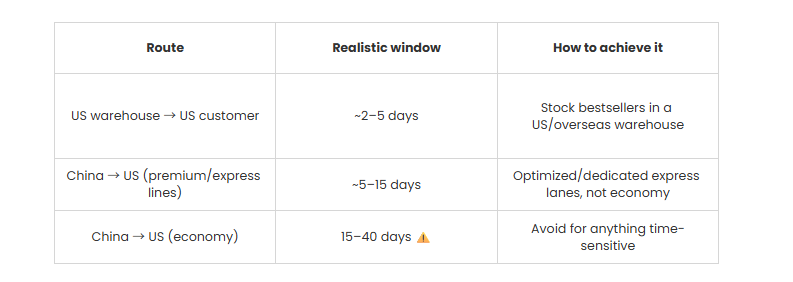
Fix the #1 conversion killer—shipping time—by routing your top 20% of SKUs to a US warehouse or express lane (2–5 days vs. 15–40).
The 4 Stages of a Shopify Dropshipping Business
Before any tactics, anchor on this map. Knowing which stage you’re in prevents the #1 cause of overwhelm — trying to do everything at once.

Most stores stall between Stage 2 and Stage 3 — not because of ads, but because their back end (sourcing, pricing, US fulfillment) can’t keep up. The rest of this guide arms each stage.
Is Shopify Dropshipping Still Worth It in 2026?
Short answer: yes, but only as a brand, not as a generic reseller. US buyers are the most demanding — and the most valuable — in the world. Here’s the honest trade-off.
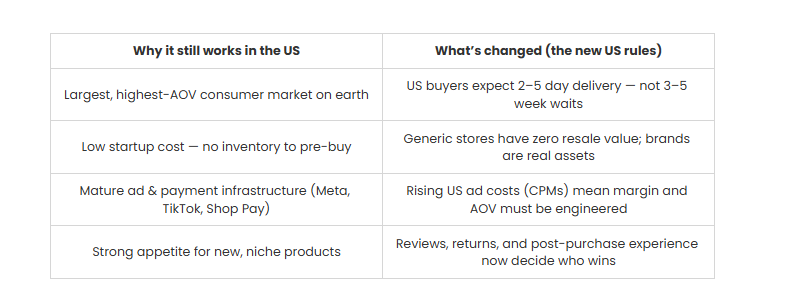
The takeaway: dropshipping is the perfect on-ramp for validation in the US, but your durable advantage comes from how well you run sourcing, pricing, and domestic-speed fulfillment — the parts customers never see but always feel.
Choose a Niche & Find Winning Products
(Stage 1: Validate)
Your product selection carries the most long-term weight. For the US, aim for high demand, defensible differentiation, and healthy margin headroom — with shipping practicality (avoid oversized/fragile items that wreck US delivery economics).
A simple winning-product scorecard
Rate any candidate 1–5 on each. Anything under 18/25 is a hard sell:
- US demand signal — proven search/scroll interest (Google Trends set to United States, TikTok, ad libraries)
- Margin headroom — can sell at 2.5–3× landed cost and still be competitive at US price points.
- “Wow” or solution-oriented factor — stops the scroll or solves a real pain.
- Low return/complaint risk — not fragile, not sizing-dependent, not easily broken in transit
- Brandability — room to add packaging, inserts, or a product improvement later
Where to research
- Trend tools: Google Trends (region = United States), TikTok Creative Center, Meta/TikTok ad libraries
- Competitor teardown: study what established US stores sell, price, and how they present offers (per Shopify's own startup steps, competitor research is a core early step)
- Order-volume filters in supplier apps to gauge real sell-through
Pro tip: Pick a niche, not a random product. A niche lets you build an email list, a brand voice, and repeat purchases — the foundations of Stages 3 and 4.
Source & Vet Suppliers
(Stage 1→2)
Your supplier is your operations team. Most beginner pain — slow US delivery, stockouts, quality complaints — traces back to a weak supplier choice.
The 7-point supplier scorecard
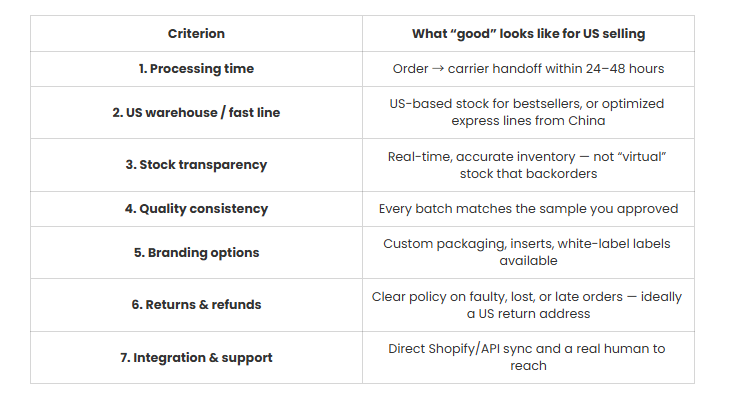
Always order a sample before committing — it’s the only way to verify real US delivery time and product quality.
Shopify Dropshipping Supplier Comparison (2026)
There is no single “best” supplier — the right choice relies on your stage. Here’s how the most common options stack up for a US-focused Shopify store:

Marketplace app vs. integrated fulfillment partner
As you move from testing to scaling, the type of supplier you need changes:
- Marketplace apps (AliExpress/DSers, etc.) — great for cheap validation; weak on US speed, branding, and QC.
- Integrated fulfillment partners / agents — combine sourcing, warehousing, QC, and logistics into one system, which is what Stage 3–4 demands.
This is where partners built specifically for scaling sellers come in. For example, FFOrder — a China-based fulfillment partner founded in 2017 — runs sourcing, warehousing, logistics, customization, and after-sales as one integrated system rather than disconnected steps, with 40,000+ vetted factory partnerships plus a 670K+ SKU library. The relevant point for your scorecard: an integrated partner is what lets you hit the processing-time, branding, and QC bars above at US volume. (See how integrated suppliers compare →)
Pricing for Profit (The Math That Most Sellers Get Wrong)
(Stage 2: Optimize)
Pricing off the supplier’s product cost is the fastest way to go broke at scale. You must price off true landed cost — and in the US, factor in higher ad costs and any applicable duties.
Step 1: Calculate true landed cost
True landed cost = product cost + shipping to US customer + payment/transaction fees + returns allowance
If you skip any of these, your net margin collapses the moment you turn on ads.
Step 2: Set a target margin you can defend
Most sustainable dropshipping stores aim for a 20–30% net margin after all costs, including ads. The non-negotiable rule:
Your dollar profit per order must be higher than your CPA (cost to acquire a customer).
- Gross margin = what’s left after product + shipping.
- Net margin = what’s left after product, shipping, fees, refunds, tools, and ads.
Step 3: Build a 3-tier price ladder (your AOV engine)
One price leaves money on the table. A simple bundle ladder raises average order value without raising ad spend:
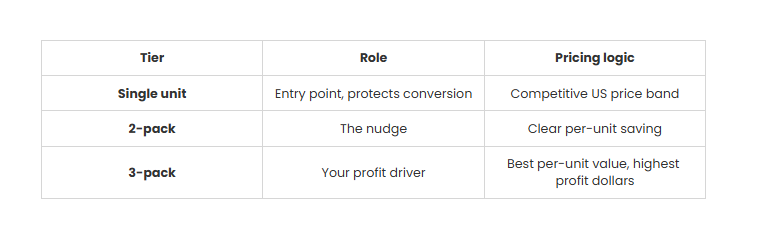
Step 4: Set guardrails
- Minimum profit per order — must beat US CPA with room to spare.
- Maximum cost ratio — if product + shipping creep above your set share of the sale price, raise price or change supplier fast.
- Repricing cadence — weekly during active testing, then every 2–4 weeks.
Pricing framework adapted from established dropshipping pricing playbooks emphasizing landed cost, net margin, and bundle ladders.
Solve the #1 Conversion Killer: Shipping Times
(Stage 3: Brand)
This is the section most guides hand-wave — and it’s the single biggest reason US stores get refunds, chargebacks, and 1-star reviews. Shopify's own cross-border guidance is blunt: standard China dropshipping means 15–40 day delivery, limited QC, no branding, and inventory-sync issues. US customers who once tolerated 2–4 weeks now expect Amazon-grade speed.
Realistic delivery times by route
The 4 levers that actually reduce US delivery time
- Move bestsellers into US/overseas warehouses — can drop delivery from 10–20 days to 2–5 days.
- Use premium/dedicated express lines strategically on your hero products.
- Keep a buffer of safety stock for proven SKUs via a 3PL.
- Automate order routing & tracking — manual CSV/email workflows quietly add days.
What “fast and reliable” looks like in practice
The operational bars that matter are dispatch speed, route coverage, and delivery reliability. As a concrete benchmark, an integrated partner like FFOrder operates with 24-hour dispatch on in-stock items (98% shipped within 24h), 100+ global logistics routes across air, sea, and rail, and a 99.8% delivery success rate — backed by a multi-warehouse network running ~60% automation and near-100% picking accuracy. It's typical end-to-end delivery windows by region:
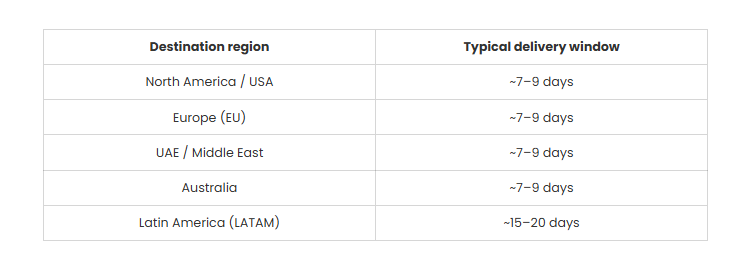
Whatever partner you choose, these are the numbers to hold them to.
Action: Don’t just “set expectations” on your product page. Re-route your top 20% of SKUs (which drive ~80% of orders) to your fastest available lane or a US warehouse. Speed on your bestsellers fixes most of your review and refund problems.
Build a Store That Converts
(Stage 2→3)
Traffic is wasted if your store doesn’t convert. Focus on these high-leverage elements for US shoppers:
- Clear value proposition above the fold — what you sell, for whom, and why you.
- Trust signals — reviews, guarantees, transparent US shipping & returns, secure-checkout badges.
- Fast, mobile-first pages — most US traffic is mobile; speed = conversion.
- Strong product pages — benefit-led copy, high-quality images/video, the bundle ladder, and an FAQ.
- Content that ranks — buying guides and blog posts improve SEO and keep customers engaged post-purchase.
💡 Quick Tool: Ever spot a competitor with a stunning store design and wonder how they built it? Instead of guessing, run their URL through this free Shopify Theme & App Detector by ShopSideK. It instantly reveals the exact theme and conversion apps they are using.
Marketing Channels That Drive Orders
(All stages)
Don’t spread thin — master one acquisition channel before adding the next.
- Paid social (TikTok, Instagram Stories, Meta): strongest ROI for product-led, scroll-stopping items.
- Google Shopping & Search: captures high-intent US buyers who are ready to purchase.
- Influencer / creator marketing: social proof and reach for emerging brands.
- Email & SMS: the profit multiplier — owns the relationship, drives repeat purchases, recovers carts.
- Content marketing / SEO: compounding, low-cost traffic over time (like the article you’re reading).
Rule of thumb: Paid ads buy you Stage 1–2 validation. Email, SMS, and brand are what make Stage 3–4 profitable as US ad costs rise.
From Store to Brand: The 2026 Moat
(Stage 4: Scale)
Generic dropshipping has zero resale value — it’s a website anyone can copy. A brand with repeat US customers, unique packaging, and improved products is a real, sellable asset. This is the leap that separates a temporary hustle from a business.
The branding ladder:
- Custom packaging & inserts (white-label) — the cheapest brand upgrade, available even while dropshipping.
- Product differentiation — small improvements based on customer feedback.
- Private label / OEM / POD — your own SKUs, your own equity.
- Multi-channel — expand toward TikTok Shop, Amazon US, and new regions on the same supply chain.
This is also why integrated partners matter at scale: capabilities like white-label shipping, custom-branded packaging, and OEM/ODM/POD at low MOQ (offered by partners such as FFOrder) are exactly the tools that turn a winning product into a defensible brand. For the bigger strategic picture, Shopify’s own direct-to-consumer guide is a strong companion read.
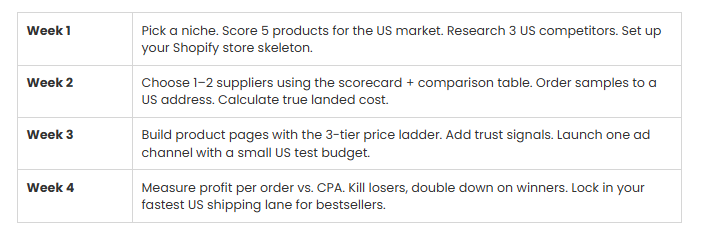
Your 30-Day Action Plan
Feeling overwhelmed? Ignore everything except this for the next month.
FAQ
Is Shopify dropshipping still profitable in the US in 2026?
Yes — but the low-effort, get-rich-quick version is gone. Profitability now belongs to US sellers who treat their store as a real brand: strong sourcing, accurate landed-cost pricing, fast and reliable domestic-speed fulfillment, and a branded customer experience. The market is still growing fast; differentiation and delivery quality decide who wins.
What is the best dropshipping supplier for a US Shopify store?
It depends on your stage. AliExpress/DSers is fine for cheap validation; Spocket and CJ help with faster US-based stock; and for scaling DTC brands that need speed, branding, and private label, an integrated partner like FFOrder fits best. Use the comparison table above and always order a sample.
How fast can dropshipped orders reach US customers?
From a US warehouse, roughly 2–5 days. From China, on premium express lines, about 5–15 days. Standard economy shipping can take 15–40 days — too slow for most US buyers, which is why moving bestsellers to a US warehouse is the highest-leverage retention fix.
How much money do I need to start?
You can launch Lean — a Shopify plan plus a modest ad-test budget. The higher cost isn’t inventory; it’s the ad spend to validate products. Budget enough to test several products properly rather than betting everything on one.
Can I add my own branding to dropshipped orders?
Yes. With white-label shipping, custom packaging, and OEM/ODM/POD options, you can ship branded orders even without holding your own inventory — the bridge from a generic store to a defensible brand.
What net margin should I target?
Many sustainable stores aim for 20–30% net margin after all expenses, with a strict minimum dollar profit per order that stays above your CPA so you can scale ads without losing money.
The Bottom Line
Shopify dropshipping in the US in 2026 isn’t won on the lowest price — it’s won on execution and certainty. Move deliberately through the four stages, pick the right supplier for your stage, get your landed-cost math right, fix your US shipping times, and build a brand customers come back to. Do that, and your store stops being replaceable.
When you reach the stage where fragmented suppliers are capping your growth, an integrated fulfillment partner is the unlock. Explore what a systemized China-to-US supply chain looks like at fforder.com — Focus Fulfills Orders.
FFOrder Team
FFOrder helps growing brands run dropshipping and fulfillment as one system — from sourcing across 40,000+ factories to global shipping and structured after-sales.
Ready to run dropshipping as an operating system?
Hit the processing-speed, branding, and QC bars at US volume. FFOrder runs sourcing, warehousing, logistics, and after-sales as one integrated system.
-1200x628%20(14).png)